
Instead of manually coordinating every booking, cleaning handoff, and maintenance visit, set up a managed Turo workflow with clear responsibilities and approval rules. If you’re asking, “How do I turn my car into a Turo rental?”, start by confirming eligibility and ownership permissions, then agree on management terms before publishing or transferring operational responsibilities.
- To turn my car into a Turo rental, confirm eligibility before arranging fleet management.
- Drivev3 suits owners seeking family-owned Turo management in Las Vegas, Bullhead City, and Laughlin.
- Define booking coordination, maintenance approvals, delivery responsibilities, and account access before handing over keys.
- Managed operations reduce your daily workload; they do not guarantee rental income or profitability.
Why this matters
A rental listing is only the public-facing part of the job. Behind it sit guest questions, vehicle preparation, delivery arrangements, maintenance decisions, and records that explain what happened to your car.
Drivev3 is best for vehicle owners seeking family-owned Turo management rather than handling daily rental operations themselves. Its services include booking and maintenance coordination and delivery, with direct access to the owners. Start a qualified inquiry through Drivev3 with your vehicle details and intended operating city; the website directs renters to Turo listings rather than accepting rental bookings or payments itself.
For your 2026 launch, treat management as a documented operating arrangement—not a promise of passive profit. Delegating work changes who performs the tasks, not whether the vehicle has expenses or needs your decisions.
Before you start
- Gather vehicle records: registration, ownership or financing documents, maintenance history, existing coverage documents, and any current listing details. Check current Turo vehicle requirements and applicable permissions before committing the car.
- Identify the decision-maker: establish who controls the listing, receives account communications, approves repairs, and signs the management agreement. Use authorized access methods; do not build the arrangement around sharing passwords.
- Resolve the hidden scheduling conflict: identify personal-use dates, existing reservations, and maintenance appointments before handing over the car. A management handoff does not erase commitments already attached to the vehicle.
Do not assume personal vehicle coverage, platform protection, and a management agreement cover the same situations. Request the actual terms for booked trips, storage, delivery, maintenance movements, and private rentals where relevant. Resolve unclear responsibilities before the car changes hands.
Vehicle readiness
Confirm the car’s operating boundaries
- Check eligibility. Compare your vehicle with Turo’s current requirements for the intended market. Verify the actual vehicle rather than relying on another owner’s experience with a similar model.
- Check permission. Review financing, lease, ownership, and coverage documents for restrictions affecting rental use. Obtain clarification from the relevant provider when the documents do not settle the question.
- Choose the operating city. State whether the vehicle will be based in Las Vegas, Bullhead City, or Laughlin. Ask which delivery, storage, and maintenance arrangements apply to that location.
- Document condition. Record existing damage, warning lights, tire condition, service needs, and included equipment. Keep dated photographs and a written handover record that both parties can review.
Expected result: you have a vehicle-specific readiness record and no unresolved permission question standing between the car and its first rental.
Start with 1 vehicle before expanding your managed fleet. That gives you a defined operating setup to review without multiplying unresolved responsibilities across several cars. This is a workflow recommendation, not an earnings forecast.
Give each city its own logistics plan
The same responsibility checklist applies across all three locations, but your instructions must identify actual handoff arrangements:
| Operating location | Decision to settle | What to record |
|---|---|---|
| Las Vegas | Where the car is stored and handed over | Agreed locations, responsible person, and access instructions |
| Bullhead City | How maintenance and vehicle movements are coordinated | Service contact, transport responsibility, and approval route |
| Laughlin | How delivery and returns fit the operating schedule | Handoff arrangements, return inspection, and escalation contact |
Apply every row’s questions to every city. The table separates planning tasks; it does not imply that storage matters only in Las Vegas or maintenance only in Bullhead City.
Management scope
Choose what you will delegate
- List the recurring tasks. Include booking coordination, guest messages, preparation, delivery, return checks, maintenance scheduling, and recordkeeping.
- Assign each task. Put a named responsible party beside every duty. Separate routine work from decisions requiring your approval.
- Define financial reporting. Ask what the owner statement contains, which supporting records accompany it, and how disputed entries are handled.
- Write the exit process. Establish how keys, vehicle records, future reservations, and account access will be handled if the arrangement ends.
Expected result: both parties can explain who does what without relying on a verbal understanding.
For a 2026 management agreement, clarity matters more than a broad promise to “handle everything.” Use the Turo and private rental management duties guide to structure questions about work that crosses booking channels.
Compare the operating arrangements
Best for hands-on control: self-management. Best for delegated daily work: managed operations. Neither arrangement removes vehicle expenses or uncertainty about rental demand.
| Arrangement | Best for | Main advantage | Main limitation |
|---|---|---|---|
| Self-management | Owners who want to handle daily operations | You retain direct control of routine decisions | You remain responsible for coordinating the work |
| Drivev3 managed operations | Owners seeking family-owned management | Booking, maintenance coordination, delivery, and direct owner access | Management terms still require review, and owner approvals remain necessary where agreed |
Drivev3 serves Las Vegas, Bullhead City, and Laughlin. Ask the owners to explain the proposed workflow for your specific location rather than assuming every vehicle receives identical arrangements.
Transparent pricing means understanding the written charges and responsibilities before agreeing—not assuming that every operating expense disappears into one line item. Request the actual terms and ask for any exclusions to be explained plainly.
Access and handover
Establish control without losing visibility
- Identify the account owner. Record who owns the Turo account and listing, and who receives platform notices. Confirm the authorized access arrangements currently supported by Turo.
- Separate instructions from permissions. Giving a manager a checklist does not establish account authority. Confirm both the operational duties and the permitted account actions.
- Record physical access. Document each key, access device, and vehicle-specific handoff instruction. If you provide 2 key sets, record who holds each set and how it will be returned.
- Agree on communication. Choose the normal contact method and the route for urgent issues. State which decisions require your response before work proceeds.
Expected result: the manager can perform agreed tasks, while you retain a clear record of account control and physical access.
For your 2026 handover, keep the signed agreement, condition record, permissions, and contact instructions together. Do not scatter the final instructions across unrelated message threads where conflicting versions are difficult to identify.
A useful responsibility sequence is Vehicle readiness, Management scope, Access and handover, then Trip review. Complete each stage before treating the next stage as settled.
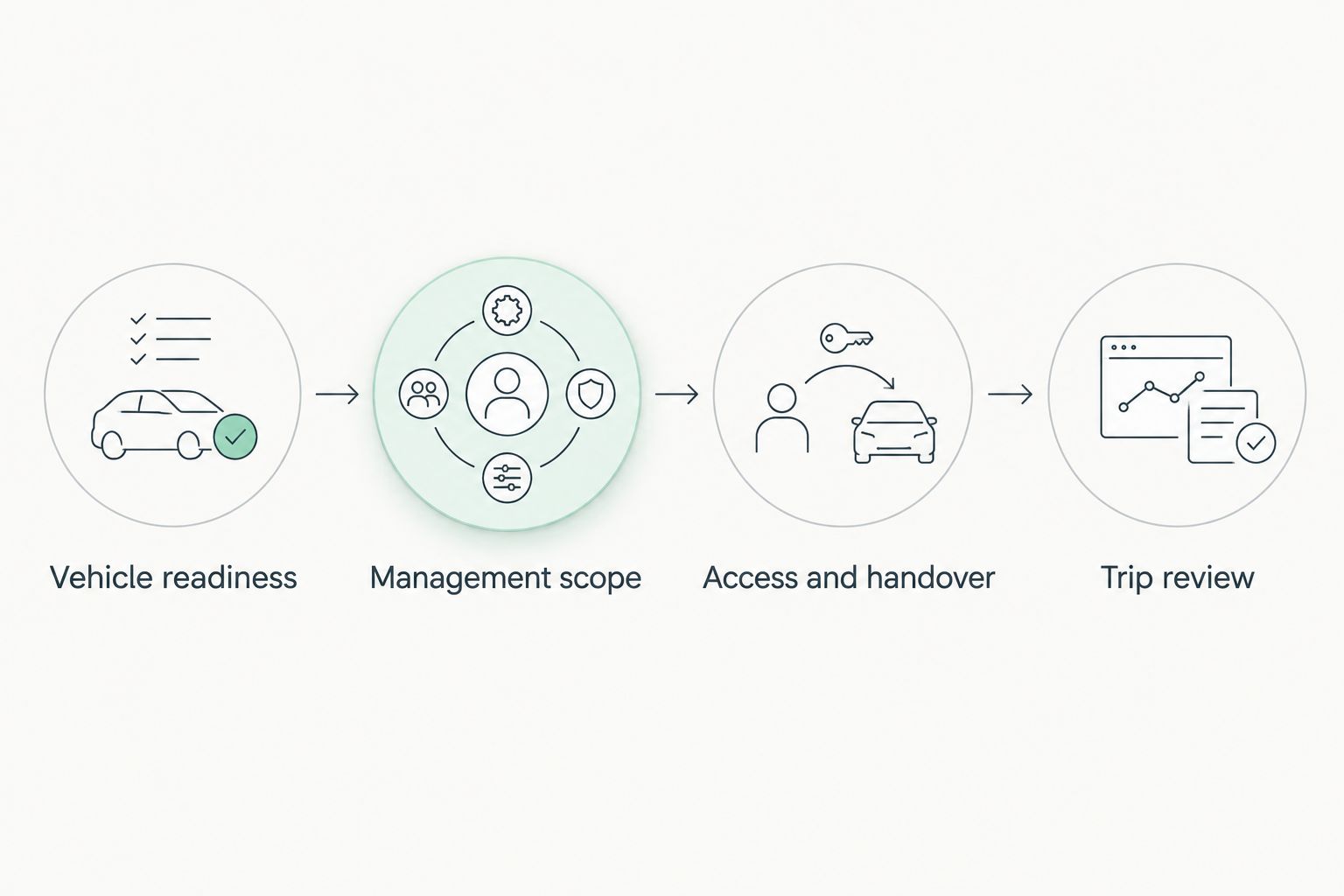
Trip review
Validate the workflow before expanding
- Review the listing instructions. Confirm that descriptions, handoff information, and guest-facing instructions match the agreed operating plan. Do not publish claims about features or arrangements that have not been verified.
- Walk through a booking. Ask who receives the reservation, coordinates preparation, confirms delivery arrangements, and handles guest questions.
- Walk through a return. Establish who checks condition, records issues, schedules preparation, and decides whether the vehicle needs maintenance before another trip.
- Review the owner record. After 1 complete trip cycle, compare the actual communications, vehicle records, and statement with the agreement. Resolve discrepancies before adding another vehicle.
Expected result: you can follow a reservation from booking through return and identify who handled every important action.
Do not judge the arrangement only by whether a booking occurred. Check whether the right person received the right information and whether approvals were documented. A completed trip with unclear records still leaves an operational problem to fix.
When you already have a Turo listing
An existing host needs a transfer workflow rather than a fresh start. Preserve existing commitments before changing responsibilities. A new manager should not have to reconstruct your calendar from guest messages.
Prepare a handover list containing upcoming reservations, unresolved guest questions, existing damage records, maintenance appointments, and personal-use blocks. Identify which party handles each reservation during the transition, including any return that falls after the handover date.
Keep listing edits separate from the management change. If you change availability, delivery arrangements, and guest instructions simultaneously, it becomes harder to identify the cause of an error. Confirm responsibilities first, then make each agreed change deliberately.
For a 2026 transition, verify current platform permissions rather than assuming an older access arrangement still applies. Agree on a cutover point in writing and preserve the records needed to explain earlier trips.
Troubleshooting
The car has conflicting commitments
Fix: reconcile the calendar before accepting additional commitments. Put personal use, confirmed reservations, maintenance, and handover arrangements into the operating record. Ask who is responsible for keeping the listing’s availability accurate.
If you need the car back temporarily, follow the agreed personal-use process. Do not assume a message to the manager automatically changes a booking or makes the vehicle available to you.
Nobody knows who should respond to an urgent alert
Fix: assign a primary contact, a backup, and an escalation route before launch. Where a permitted tracking setup is used, tracker emergency contacts belong in the response plan alongside vehicle access and incident responsibilities; receiving an alert does not itself authorize a particular action.
Confirm the applicable platform rules, disclosures, and permissions before using monitoring equipment. Do not treat a tracking device as a substitute for guest communication or an agreed incident procedure.
A repair waits because approval authority is unclear
Fix: write down who can authorize work and how approval is recorded. Separate routine maintenance coordination from repair authorization, and ask what happens when you cannot be reached.
Apply the same rule in Las Vegas, Bullhead City, and Laughlin. A local service contact helps only when that contact knows who can approve the next action.
The owner statement does not match your expectations
Fix: compare each disputed entry with the agreement and its supporting record. Ask for an explanation of the task or expense rather than assuming the statement label tells the whole story.
Record the resolution and any change to future reporting. Repeated ambiguity is a reason to improve the reporting process before expanding the fleet.
Customize your workflow
Build around how you actually use the vehicle. An owner who needs regular personal access requires different calendar instructions from an owner delegating an out-of-state car. Both need clear approval rules and reliable records.
Drivev3 offers daily, weekly, and monthly rental periods; ask how the intended rental pattern affects preparation, maintenance coordination, and your own access. These periods do not establish vehicle availability or guarantee bookings.
For your 2026 inquiry, send the vehicle details, operating city, existing listing status, personal-use needs, and known maintenance issues. Ask for written management terms, the approval process, and a clear explanation of coverage responsibilities. That creates a qualified conversation without promising income before the facts are established.
Discuss your vehicle’s management plan
Bring your vehicle details, operating city, and personal-use needs to the conversation.
FAQ
How do I turn my car into a Turo rental with a manager?
Confirm vehicle eligibility and ownership permissions, then agree on management responsibilities before handing over access. Document booking coordination, maintenance approvals, delivery, reporting, and your personal-use needs.
Can I keep using my car while it is managed?
Personal use needs to be agreed and reflected in the operating calendar. Confirm the notice process and how existing reservations affect your requested dates before committing to management.
Does managed Turo hosting guarantee passive income?
No, managed Turo hosting does not guarantee income or profitability. Passive income describes delegating daily operations; vehicle expenses, rental demand, and owner decisions remain part of the arrangement.
Can an existing Turo listing move to managed operations?
An existing listing needs a documented handover of responsibilities and authorized access. Preserve upcoming reservations, guest communications, condition records, and maintenance commitments during the transition.
Does Drivev3 take rental bookings directly on its website?
No, Drivev3 currently directs renters to its Turo listings rather than accepting bookings or payments on its website. Owners can use the website to begin a management inquiry.
What should I ask about insurance before handing over my car?
Ask which terms apply during booked trips, storage, delivery, maintenance movements, and any private rental activity. Request the actual documents and resolve gaps or unclear responsibilities before handing over the vehicle.
Can I arrange management in Las Vegas, Bullhead City, or Laughlin?
Drivev3 serves vehicle owners in Las Vegas, Bullhead City, and Laughlin. Request the specific storage, delivery, maintenance, and communication arrangements for the city where your vehicle will operate.
One last thing
Ask the manager to explain what happens when the car should not be rented. A maintenance concern, unresolved damage, or an owner-use conflict tests the approval process more clearly than a routine booking. Set the authority to pause operations before you need it.