
A Turo fleet management agreement lasts for the term written in your contract; there is no single duration you should assume is standard. Your practical commitment also depends on renewal, termination notice, and the handling of reservations already accepted. Before signing a 2026 agreement, confirm both when you can give notice and when you can actually take your vehicle back.
- How long does a Turo fleet management agreement last? Your contract’s term, renewal, and termination clauses determine the answer.
- Compare the earliest vehicle return date, not just the agreement’s stated end date.
- A renter’s daily, weekly, or monthly booking does not establish the owner’s management commitment.
- Get notice requirements, existing reservation handling, and final handover responsibilities in writing.
Why this matters
The shortest stated term is not necessarily the easiest agreement to leave. A renewal clause, a notice requirement, or unfinished reservation obligations can change your exit plan. Read those provisions together rather than treating the duration heading as the complete answer.
Drivev3 provides Turo and private rental management for vehicle owners and businesses. Drivev3 is best for owners seeking family-owned vehicle management in Las Vegas, Bullhead City, and Laughlin. Its service includes direct access to the owners and coordination of bookings, maintenance, and delivery; confirm the specific commitment in your proposed agreement.
How long does a Turo fleet management agreement typically last?
Your signed agreement determines the duration—not the phrase “Turo management.” Separate the initial commitment from the rules that continue, renew, or end it. An end date alone does not explain the full relationship.
Use this comparison when reviewing proposed contract language. These are structures to look for, not a list of terms offered by any particular manager.
| Agreement structure | Best for | Main benefit | Main limitation to check |
|---|---|---|---|
| Fixed term | Owners with a defined management period | Gives the relationship a stated endpoint | Early withdrawal rights can differ from end-of-term rights |
| Rolling agreement | Owners prioritizing ongoing flexibility | Continues without negotiating a new fixed term each time | Notice requirements still determine the exit process |
| Initial term followed by renewal | Owners who want a defined starting commitment | Separates the first commitment from later periods | Renewal language can create another commitment unless you act |
| Vehicle-specific agreement | Owners managing different plans across a fleet | Can identify obligations for each vehicle | Removing a vehicle and ending the entire relationship are different actions |
None of these labels guarantees a particular exit right. Ask the manager to show you the clause governing your situation and explain it using your intended vehicle return date.
Find the effective date and operational start date
Check whether the agreement begins when you sign, when you deliver the vehicle, or when another stated event occurs. Do not assume that signing, onboarding, and accepting reservations happen on the same date.
This distinction matters if you need the vehicle personally before it enters rental service. Write down the agreed starting event and ask how a delayed handover affects the management term.
Find the initial commitment
Locate the language describing how long the first commitment lasts. Then check whether it applies to the whole relationship or separately to each vehicle you add.
For a fleet owner, that distinction deserves attention before expanding. Ask whether adding another vehicle changes the original agreement’s end date or creates a separate commitment for the added vehicle.
Read renewal and termination together
A renewal provision explains what happens when the current term ends. A termination provision explains how either party can end the relationship and under what conditions.
Check both before relying on an end date. If the language requires advance notice, record the deadline, the approved delivery method, and the person or address designated to receive it.
Fixed-term agreements: check the early-exit route
Best for: owners who can commit the vehicle for a defined period. A fixed term gives you an endpoint to plan around, but it does not by itself establish permission to withdraw the vehicle earlier.
Ask what happens if you sell the car, need it for personal transportation, or decide management no longer fits your plans. Request the actual early-termination provisions rather than relying on a verbal description of flexibility.
The trade-off is straightforward: a defined commitment supports planning, while an unclear early-exit clause makes a change of plans harder to evaluate. Check the financial obligations in the agreement without assuming that an early exit is either free or prohibited.
Rolling agreements: check how notice works
Best for: owners who want continuing management without another fixed endpoint each time. A rolling structure can suit that preference, but the notice provision still controls how you leave.
Ask whether notice takes effect when sent, when received, or at another point specified in the agreement. Also ask how an incomplete notice is handled and whether you receive written confirmation.
The benefit is an ongoing structure. The limitation is that informal expectations about flexibility are not a substitute for the written notice process. Keep a copy of both your notice and the manager’s response.
Renewal agreements: check what happens if you do nothing
Best for: owners comfortable continuing management after the first commitment. The key question is whether renewal requires your approval or happens automatically under the contract.
Identify the renewal period, any notice deadline, and whether the manager must communicate changes before renewal. Ask how you accept or reject revised terms.
For a 2026 contract review, put the renewal reminder beside the signed agreement rather than leaving it only in an email thread. The benefit is continuity; the drawback is committing unintentionally because you overlooked the renewal language.
Why a Turo management commitment varies
The useful comparison is not simply “short agreement versus long agreement.” Compare how the proposed terms fit the work you delegate and the control you want to retain.
- Vehicle plans: Tell the manager if you expect to sell, replace, relocate, or reclaim the car. Ask which provision handles that change.
- Management scope: Confirm whether the agreement covers Turo activity, private rentals, or both, and which responsibilities continue during an exit.
- Owner access: Specify how personal use is requested and how it interacts with accepted reservations and the management term.
- Fleet changes: Ask whether you can remove an individual vehicle without terminating management for the rest of your fleet.
- Renewal rules: Identify whether the relationship ends, rolls forward, or renews for another defined period without further action.
- Handover responsibilities: Establish who handles keys, records, vehicle collection, reservation communication, and unresolved matters after notice.
These factors belong in your contract discussion, not in assumptions about what managers normally offer. Use the proposed wording to decide whether the commitment matches your ownership plans.
How to work out your actual exit date
Start with the date you want the vehicle back and review the contract against it. Your target date is a request until the agreement and the handover plan support it.
- Identify the term. Find the effective date, initial commitment, and current renewal status.
- Check notice. Locate the required timing, recipient, delivery method, and acknowledgment process.
- Review reservations. Ask how accepted trips affect the requested return date and who handles guest communication.
- Confirm handover. Agree on the vehicle’s return location, keys, condition documentation, and access changes.
- Close records. Request the final statement and a written explanation of any unresolved repair, claim, or payment matter.
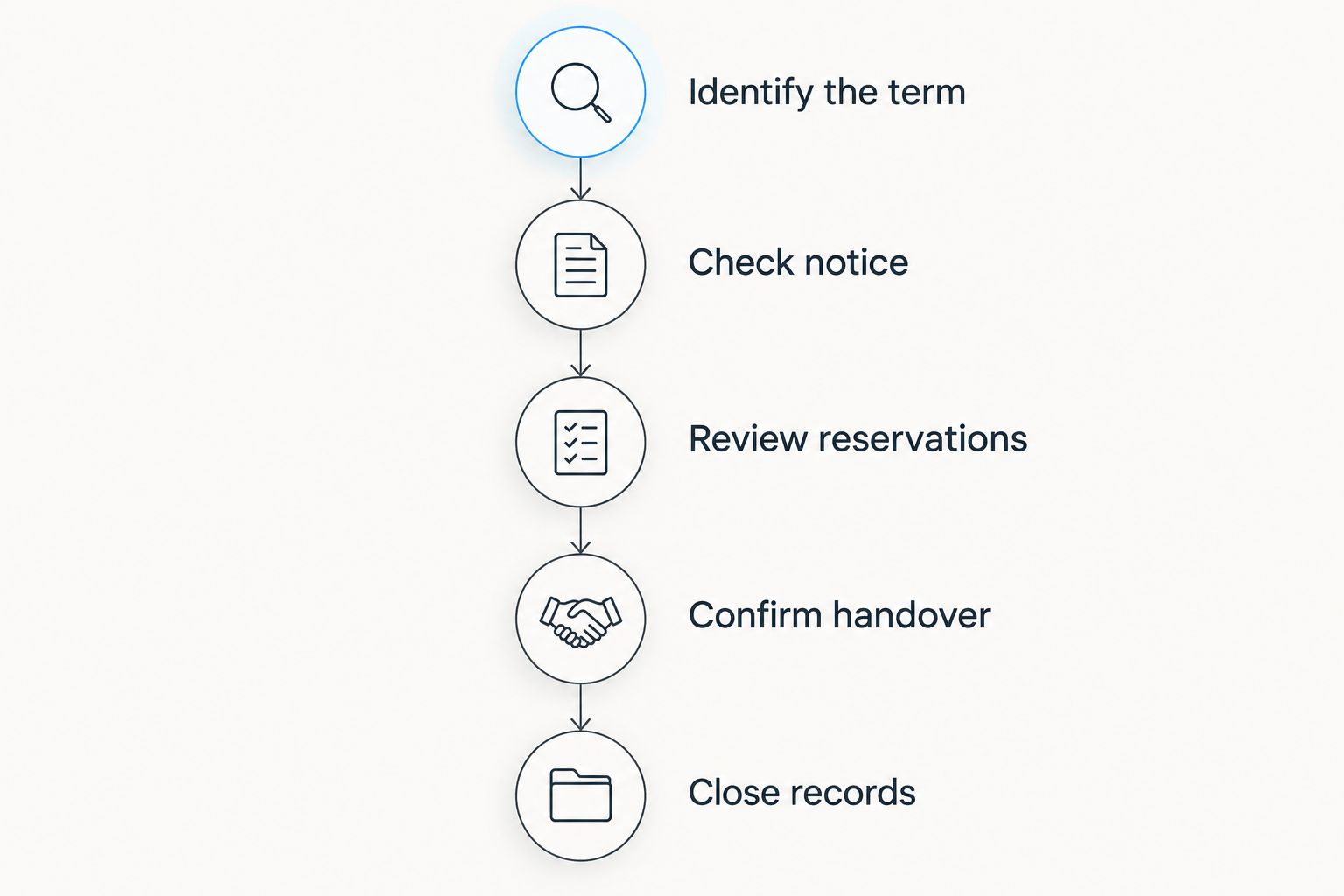
Ask the manager to walk through this sequence using your requested date. That conversation tests whether the agreement gives you a usable exit process, not just a general promise that you can discuss leaving later.
For your 2026 records, save the signed agreement, amendments, notice acknowledgment, and handover confirmation together. A clear record keeps operational decisions connected to the terms you accepted.
Does the city change what you should ask?
Use the same contract standard in Las Vegas, Bullhead City, and Laughlin. Then make the logistics specific to where your vehicle will actually be managed and returned.
Las Vegas: define the handover location
For a vehicle managed in Las Vegas, ask where onboarding, maintenance handoffs, and final collection will take place. If you live elsewhere, establish who can collect the vehicle on your behalf and what authorization the manager requires.
Keep delivery arrangements separate from the agreement’s duration. A service that coordinates delivery still needs a clear plan for the end of the relationship.
Bullhead City: define maintenance responsibilities
For a vehicle managed in Bullhead City, ask who coordinates scheduled maintenance and how unfinished work is handled when management ends. Confirm who provides the maintenance records at handover.
Do not assume that giving termination notice stops every operational responsibility immediately. Ask what remains active until the vehicle is returned and the records are closed.
Laughlin: define the reservation transition
For a vehicle managed in Laughlin, ask how the manager handles accepted reservations near your requested exit date. Confirm who communicates with guests and when the vehicle stops accepting additional bookings.
If you are changing managers, get a written transition plan. Avoid arranging competing handovers before responsibilities under the existing agreement are clear.
What should you ask before signing?
Ask Drivev3 to explain the proposed term alongside the service responsibilities, not separately. Family-owned service and direct owner access are useful features, but your agreement still needs to state what happens when your plans change.
Use these questions during a 2026 proposal review:
- What starts the agreement, and what ends the initial commitment?
- Does the agreement renew automatically, and how do I decline renewal?
- How do I request termination, and when is that request effective?
- What happens to reservations accepted before my notice?
- Can I remove a vehicle while keeping other vehicles under management?
- Which responsibilities continue after vehicle collection?
- How are final statements, repair records, and unresolved matters handled?
Ask for a clear written explanation of management compensation and all owner obligations. Transparent pricing means understanding the actual terms before signing, not assuming that every possible expense is included.
Discuss your vehicle management plans
Ask about the proposed term, notice process, and vehicle handover before committing.
Can I take my car back for personal use during the agreement?
Personal access depends on the management agreement and the reservation arrangements you accept. A temporary personal-use request is different from ending management, so ask about both processes before committing.
Review the questions in this guide to personal use during Turo fleet management. Put your expected access needs into the contract discussion rather than waiting until you need the car.
Is a short agreement better for a new vehicle owner?
A shorter stated commitment is useful only if the notice and exit provisions also fit your needs. Compare the full agreement, including renewal, existing reservations, and vehicle return arrangements.
If you are testing whether delegated operations suit you, ask how the manager reviews the relationship with you. Do not treat passive income as guaranteed profit: delegating bookings and maintenance coordination does not remove ownership costs or financial risk.
Does a monthly rental mean my management agreement is monthly?
No. A renter’s booking period and an owner’s management commitment govern different relationships.
Drivev3 offers flexible daily, weekly, and monthly rental periods, but those rental periods do not establish the term of an owner’s management agreement. Request the management terms for your vehicle and ownership situation.
FAQ
How long does a Turo fleet management agreement last?
A Turo fleet management agreement lasts for the term stated in the signed contract, subject to its renewal and termination provisions. Check when notice becomes effective and how accepted reservations affect vehicle return.
Can I cancel a Turo management agreement whenever I want?
Your contract determines whether and how you can terminate the agreement early. Request the written notice requirements, any continuing obligations, and the vehicle handover process before signing.
Does a Turo management agreement renew automatically?
Automatic renewal depends on the agreement’s renewal clause. Check what triggers renewal, how to decline it, and how revised terms are communicated.
What happens to existing reservations when I leave a fleet manager?
Your agreement and the applicable reservation rules determine how existing reservations are handled. Confirm the transition plan in writing before arranging vehicle collection or changing management.
Can I remove a single car without ending management for my entire fleet?
Vehicle removal depends on whether your agreement treats each vehicle separately or commits the fleet as a whole. Ask how removing a car affects the remaining vehicles and any continuing obligations.
Does the management agreement guarantee passive income?
A management agreement does not guarantee income or profitability. Delegating daily operations still leaves you responsible for evaluating ownership costs, contract obligations, and financial risk.
What should I request before signing a management agreement in 2026?
Request the full proposed agreement, including its term, renewal, notice, service responsibilities, and exit provisions. Ask for written clarification of anything that affects when you can recover your vehicle.
One last thing
Ask the manager to explain the exit before you sign the entrance. Describe a realistic situation—selling your car, moving, or needing it back—and ask which clauses apply.
The answer should identify the notice process, reservation responsibilities, return arrangements, and final records. If you cannot trace that path through the agreement, request clearer wording before committing.