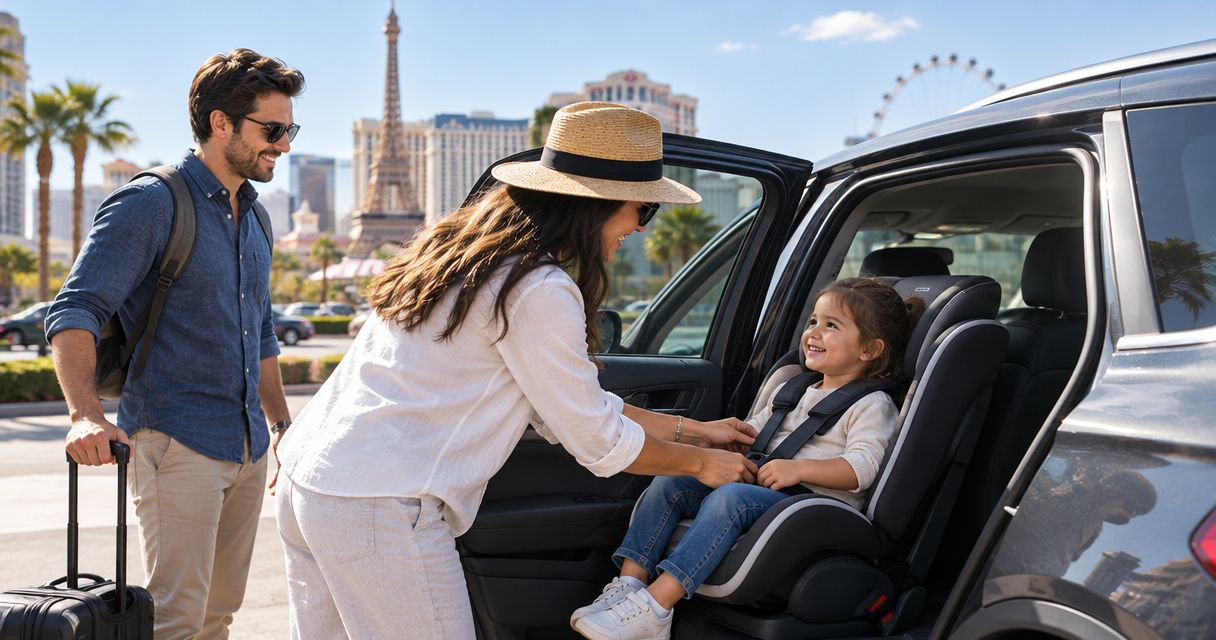
For car rentals in Las Vegas, check that the child seat fits your child, installs correctly in the exact vehicle, and has a known history before you drive away. Confirm who supplies it and which instructions apply; a reservation note alone does not establish that a suitable seat will be at pickup.
- For car rentals Las Vegas families should confirm child-seat fit, vehicle compatibility, and installation before departure.
- Drivev3 offers family-owned rental management; child-seat provision and installation assistance require specific confirmation.
- NHTSA recommends keeping children in the back seat through age 12.
- Use the same pickup checks in Las Vegas, Bullhead City, and Laughlin; verify laws for your entire route.
Why this matters
A vehicle can have enough passenger seats without having a suitable position for your child's restraint. Rear-seat space, approved anchor positions, and access to seat belts all matter more than the vehicle category shown in a listing.
For your 2026 trip, settle the child-seat arrangements before choosing the handoff location. Drivev3 directs renters to its Turo listings rather than taking rental bookings or payments on its website; confirm vehicle-specific arrangements through the actual booking process.
What should you check when using child seats in Las Vegas rentals?
Check the child, the restraint, and the exact vehicle together—not separately. NHTSA's car-seat guidance makes the child's age and size, the restraint manufacturer's instructions, and the vehicle owner's manual central to correct selection and installation.
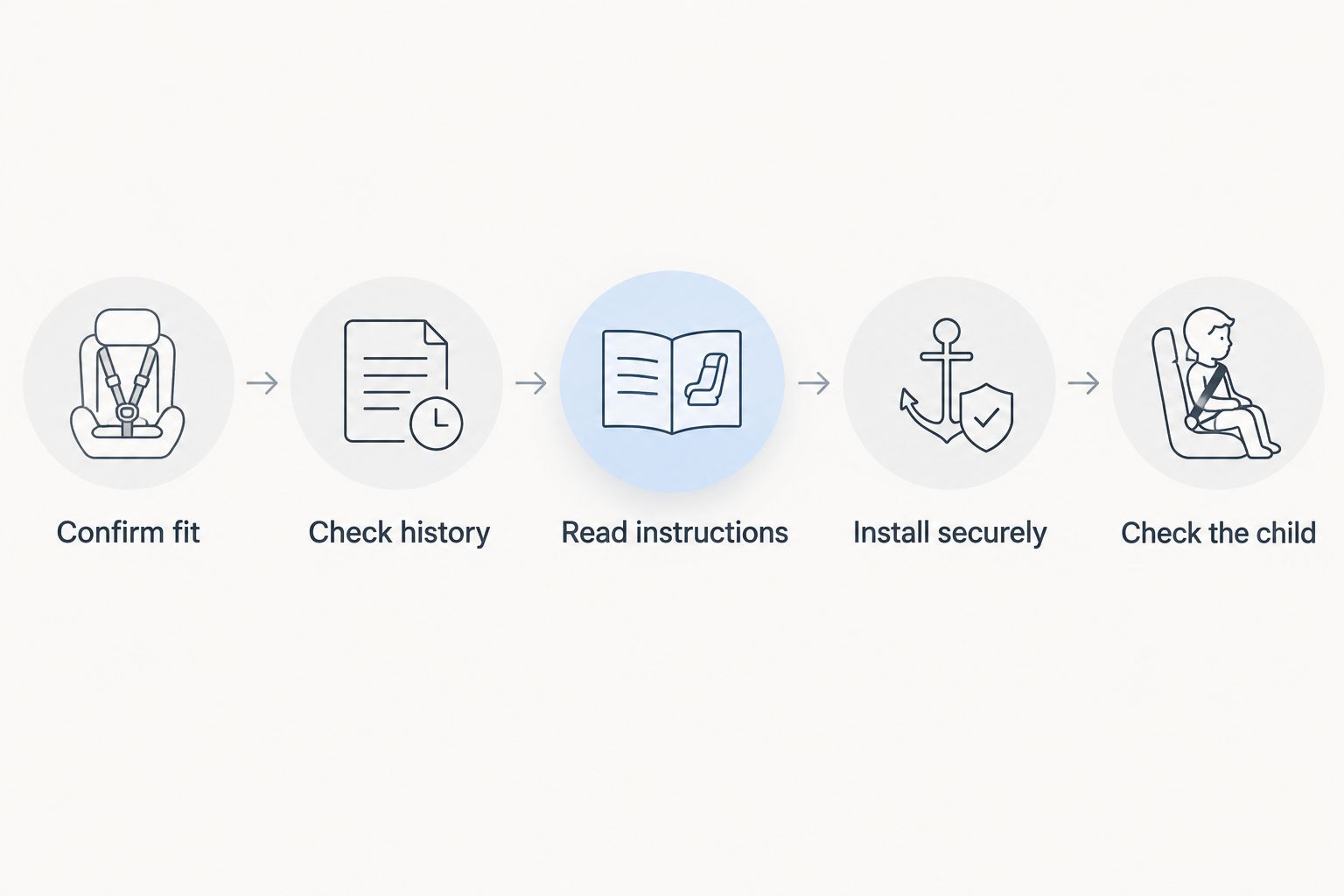
Use this sequence before departure:
- Confirm fit. Record your child's current height and weight. Choose a restraint mode permitted by the seat's instructions, keeping children rear-facing until they reach the manufacturer's rear-facing height or weight limit.
- Check history. Read the model information, manufacture date, and expiration guidance. Check recalls and whether the seat's crash history meets the manufacturer's reuse instructions.
- Read instructions. Use both manuals to identify an approved seating position, the correct belt path, and any lower-anchor or tether restrictions.
- Install securely. NHTSA advises that an installed harnessed seat should not move more than 1 inch side-to-side or front-to-back when checked at the belt path.
- Check the child. Set the harness or booster belt position correctly, then check access to the buckle and the space around the restraint.
Do not continue with a loose installation, missing instructions, or an unresolved fit problem. Arrange a suitable alternative before transporting your child.
Bring your own seat or request one?
Bringing a familiar seat reduces uncertainty about its history, but it does not remove the need to check rental-vehicle compatibility. Requesting a seat avoids transporting your own, but requires advance confirmation of the exact restraint and its condition.
Neither choice guarantees a correct installation. For a 2026 reservation, compare the actual arrangements rather than assuming that a child-seat request covers every detail.
| Option | Best for | Main benefit | Limitation to resolve |
|---|---|---|---|
| Bring your own seat | Families who know their restraint's history and adjustments | Familiar instructions and harness settings | You must transport it and confirm compatibility with the rental |
| Request a supplied seat | Families who want to avoid carrying a restraint | Removes the need to transport your own seat | Exact model, condition, history, and provision need confirmation |
If you bring your own, inspect it after travel and keep the manual accessible. If you request one, ask for the model before accepting the arrangement; a generic description such as infant seat or booster is not enough to establish fit.
Do not assume the person handing over the vehicle is trained to install child restraints. Ask what assistance is actually offered and who is responsible for installation.
What changes between rear-facing, forward-facing, and booster seats?
The correct restraint depends on your child and the manufacturer's limits, not simply on which seat is easiest to obtain. NHTSA recommends progressing through restraint stages only when the child outgrows the preceding stage under the applicable instructions.
| Restraint | Best for | What to check | Practical limitation |
|---|---|---|---|
| Rear-facing seat | Children within its rear-facing limits | Approved recline, correct belt path, harness position | Can affect the usable space for a front passenger |
| Forward-facing harnessed seat | Children who have outgrown rear-facing limits | Harness fit, installation method, top tether | Requires an approved tether anchor and routing |
| Belt-positioning booster | Children who have outgrown a harnessed seat and can sit properly | Lap-and-shoulder belt placement | Requires consistent upright sitting throughout the ride |
Rear-facing seats: check recline and front-seat clearance
Use the restraint's recline indicator and instructions. Do not add padding, positioning devices, or accessories unless the manufacturer permits them.
Check the vehicle manual for restrictions on contact with the front seat. The driver and front passenger still need to sit and use their restraints correctly.
Forward-facing seats: identify the tether anchor
NHTSA recommends using the top tether with a forward-facing harnessed seat according to the restraint and vehicle instructions. Identify the actual tether anchor; a cargo hook is not a substitute.
Check the permitted installation method and weight limits. Do not assume lower anchors remain appropriate throughout the seat's full harnessed weight range.
Boosters: inspect the belt on the child
The lap belt should lie low across the upper thighs, not the stomach. The shoulder belt should cross the chest and shoulder rather than the neck or face.
NHTSA says children commonly need a booster until seat belts fit correctly, typically between 8 and 12 years old. Age alone does not establish belt fit, and NHTSA recommends keeping children in the back seat through age 12.
Why child-seat arrangements vary
Your 2026 child-seat plan needs to account for the specific restraint, vehicle, and handoff—not just the reservation dates.
- Child size: Height and weight determine which manufacturer limits apply.
- Restraint design: Belt paths, recline requirements, and permitted installation methods differ.
- Vehicle seating: Approved anchor positions and rear-seat geometry differ between vehicles.
- Passenger needs: Other passengers still need usable seats and correctly fitting restraints.
- Handoff arrangements: You need access to the vehicle, instructions, and enough time to check the installation before leaving.
- Travel route: Applicable child-restraint laws depend on where you drive, including interstate travel.
A larger vehicle is not automatic proof of a better installation. Confirm the exact seating arrangement, especially when fitting multiple restraints or preserving access to another row.
What should you confirm in each pickup city?
Las Vegas, Bullhead City, and Laughlin need the same safety checks. The useful local distinction is your actual pickup, return, and travel plan—not an assumption that one city's vehicles or handoffs are better suited to families.
Las Vegas: agree on the handoff before arrival
For a Las Vegas pickup, ask where you can inspect the vehicle and install the restraint before departure. Confirm the exact vehicle, who supplies the seat, and how a vehicle substitution would be handled.
Do not make a tight onward schedule depend on an unchecked installation. Put the child-seat request in the booking conversation so the person arranging the handoff can respond to the specific requirement.
Bullhead City: include the full route in your request
For a Bullhead City pickup, explain whether your itinerary stays in Arizona or includes Nevada. Check the current official child-restraint requirements for each state on your route; pickup location alone does not determine every rule that applies.
Confirm the pickup and return arrangements separately. If you bring a restraint, give the vehicle provider its model and intended seating position rather than asking only whether the car is family-friendly.
Laughlin: check the return plan as carefully as pickup
For a Laughlin pickup, identify where you will install the restraint and where you will remove it at return. Ask what happens to a supplied seat at the end of the booking.
If your itinerary includes Bullhead City or Las Vegas, describe those stops when discussing the rental terms. Do not assume that service across all three cities means every cross-city delivery or return arrangement is included.
What should vehicle owners and fleet managers document?
Drivev3 is best for owners seeking family-owned rental management in Las Vegas, Bullhead City, and Laughlin. Its booking, maintenance, and delivery coordination are relevant to family-trip planning, but child-seat supply and installation services still require explicit confirmation.
For owners, delegated daily operations do not remove the need for clear responsibilities. Build a child-seat response into the rental management duties you agree with your manager.
For your 2026 operating checklist, document:
- Whether child-seat requests are accepted and who answers them.
- Whether any restraint is supplied, and who maintains its records.
- How guests receive the exact vehicle and restraint information.
- Who addresses a vehicle substitution or reported fit problem.
- How inspection concerns are escalated before departure.
Family-owned service and direct access to the owners give you a clear point of contact. They do not establish restraint compatibility, insurance coverage, or an installation qualification. Request the actual rental or management terms, including all charges, rather than inferring them from a service description.
Discuss your rental or management needs
Share your city, vehicle, and child-seat questions before agreeing to rental or management arrangements.
Can you use a seat belt instead of lower anchors?
A seat belt is an approved installation method when the child-restraint and vehicle instructions permit it. Lower anchors are not automatically safer than a correctly used seat belt.
Follow the applicable weight limits and locking instructions. Do not use the seat belt and lower anchors together unless both manufacturers explicitly allow that combination.
What if the rental vehicle changes at pickup?
A vehicle change requires a fresh compatibility and installation check. Approval for the original vehicle does not establish that the replacement has the same seating positions, anchors, or available space.
Recheck every installed restraint before departure. If the replacement does not accommodate your family safely, resolve the vehicle arrangement before driving away.
FAQ
What should I check first when arranging car rentals in Las Vegas with a child seat?
Confirm your child's height and weight, the exact restraint, and the exact rental vehicle first. Then verify an approved seating position and installation method using both manufacturers' instructions.
Does Drivev3 provide child seats with every rental?
Do not assume a child seat is included with a Drivev3 rental. Ask about the specific vehicle and booking, including who supplies the restraint and what assistance is offered.
How much should an installed car seat move?
A harnessed car seat should not move more than 1 inch side-to-side or front-to-back at the belt path, according to NHTSA. Check movement where the belt or lower-anchor strap passes through the restraint, not at the top of the shell.
When can my child stop using a booster in a rental car?
Your child should stop using a booster only when the vehicle seat belt fits correctly and applicable legal requirements are met. NHTSA says correct belt fit typically occurs between 8 and 12 years old; check the fit in the actual rental vehicle.
Can my child ride in the front seat of the rental?
NHTSA recommends that children remain in the back seat through age 12. Follow the restraint instructions, vehicle warnings, and applicable law; never put a rear-facing restraint in front of an active passenger airbag.
Should I check different rules when driving between Laughlin and Bullhead City?
Yes, check the current official child-restraint laws for both Nevada and Arizona when your route includes both states. Follow your restraint's instructions as well; meeting a legal minimum does not establish correct installation.
Can I book and pay for a rental directly on the company website?
The company website currently directs renters to its Turo listings rather than taking rental bookings or payments itself. Confirm child-seat arrangements through the actual booking conversation before committing to the trip.
One last thing
The most useful final check happens with your child sitting in the installed restraint. An empty seat cannot show you whether the harness needs adjustment or whether a booster positions the vehicle belt correctly.
For your 2026 departure, make that occupied fit check part of the handoff—not something you postpone until the first stop. If anything remains unresolved, keep the vehicle parked while you address it.