
Rental car management should separate Turo and private-rental duties in writing: who accepts bookings, verifies drivers, coordinates delivery, approves maintenance, handles incidents, and reconciles owner statements. Shared vehicles need one availability record, but each booking needs its own channel-specific paperwork and responsibility trail. A manager handling both channels does not make their insurance, payment, or contract requirements interchangeable.
- Rental car management needs separate Turo and private-rental workflows, even when the same manager handles both.
- Drivev3 serves owners seeking family-owned rental car management in Las Vegas, Bullhead City, and Laughlin.
- Assign booking, delivery, maintenance, and incident duties before handing over a vehicle.
- Treat passive income as delegated operations, never guaranteed profit.
Why this matters
A booking handoff can look simple while leaving important decisions unassigned. If a guest requests an extension during scheduled maintenance, somebody must decide whether the vehicle stays rented, returns for service, or becomes unavailable.
Drivev3 is best for owners seeking family-owned rental car management in Las Vegas, Bullhead City, and Laughlin. Its service includes booking and maintenance coordination and delivery, with direct access to the owners. Start a management inquiry through Drivev3 by identifying your vehicle, its location, and the duties you want delegated.
For a 2026 management agreement, focus on responsibility rather than a promise of passive income. Delegating work does not remove your need to understand expenses, approve decisions, or review results.
How should rental car management separate Turo and private-rental duties?
Separate the work by booking channel first, then assign responsibility for each task. Use 2 booking channels as distinct operating tracks: Turo and private rental. Keep a shared vehicle calendar so neither track treats the same car as independently available.
The table below is an owner checklist, not a statement of any manager's contract terms. Ask the proposed manager to fill in the responsible person and supporting document for every row.
| Duty | Turo booking track | Private-rental track |
|---|---|---|
| Booking confirmation | Identify who manages the listing and confirms trip details | Identify who accepts the reservation and records agreed terms |
| Driver checks | Confirm the current platform process and assigned host tasks | Establish the verification process and responsible party |
| Payment handling | Identify platform transactions and owner reconciliation duties | Identify payment collection, records, and reconciliation duties |
| Delivery and return | Record the trip handoff instructions and assigned operator | Record the agreed handoff instructions and assigned operator |
| Insurance coordination | Review the applicable trip terms and responsibilities | Confirm the applicable rental arrangement with qualified advisers |
| Incident handling | Assign reporting, evidence collection, and communication | Assign reporting, evidence collection, and communication |
| Owner reporting | Separate trip activity, expenses, and adjustments | Separate rental activity, expenses, and adjustments |
Turo is best for owners choosing a platform-based booking workflow. Its advantage is keeping platform bookings within a defined operating channel; its limitation is that those procedures do not establish the terms for a separate private rental.
Private rental is best for owners prepared to establish a separate rental workflow. Its advantage is a separately documented agreement with the renter; its limitation is that you must explicitly assign administration rather than assume the platform handles it.
Turo duties: document the platform workflow
For Turo management in 2026, ask who controls listing changes, calendar updates, guest messages, trip handoffs, and post-trip follow-up. Record who can approve an extension or change delivery arrangements. Do not treat account access as proof that someone has authority to make every decision.
Give the manager a written approval boundary. Routine coordination and decisions that commit you to additional work or expense should not sit in the same undefined category.
Before signing, ask these practical questions:
- Who checks the current platform requirements before changing the operating process?
- Who answers guest messages when the usual contact is unavailable?
- Who records a booking change and updates the shared calendar?
- Who tells you about an incident, and through which agreed communication channel?
The benefit of delegation is fewer daily tasks on your desk. The trade-off is less direct involvement in each interaction, which makes written instructions and accessible records more important.
Private-rental duties: establish a separate agreement trail
A private rental needs its own documented workflow. Ask who prepares the agreement, confirms the driver's information, handles payments, records vehicle condition, and manages return changes. Get professional advice on legal and insurance questions rather than relying on a manager's general description of the service.
For your 2026 operating plan, request the actual documents that govern private rentals. A verbal explanation that a vehicle is covered does not explain exclusions, reporting duties, or which party must act after an incident.
Keep the renter-facing agreement separate from your owner-management agreement. One describes the renter's obligations; the other should describe what the manager does for you and what still requires your decision.
Do not move a booking between channels without reviewing the resulting obligations. A scheduling change should not silently become a change in payment handling, documentation, or insurance arrangements.
Why rental car management duties vary
The right division of work depends on the operation you are handing over. Use these factors to define the service before comparing proposals:
- Booking channel: Turo and private rentals need separately documented procedures.
- Vehicle type: Teslas, SUVs, sedans, and slingshots require instructions appropriate to the vehicle being managed.
- Operating location: Las Vegas, Bullhead City, and Laughlin each need an agreed handoff location and responsible operator.
- Rental period: Daily, weekly, and monthly arrangements need clear rules for extensions, returns, and maintenance coordination.
- Owner involvement: Decide which routine actions are delegated and which decisions require approval.
- Delivery responsibility: Name who prepares, transports, hands over, and receives the vehicle.
Avoid a proposal that names these services without defining their boundaries. Maintenance coordination, for example, should explain who arranges the work, who authorizes it, and how the vehicle's booking status gets updated.
Build a handoff process before the first rental
Organize each rental into 3 stages: before departure, during rental, and after return. Use the same stage names across both channels, while keeping the underlying documents separate. This makes responsibilities easier to compare without pretending the requirements are identical.
- Before departure: Confirm the booking channel, assigned driver checks, vehicle condition record, handoff instructions, and applicable documents. Resolve unanswered questions before releasing the vehicle.
- During rental: Assign guest communication, extension requests, maintenance alerts, and incident escalation. Record changes where the next operator can find them.
- After return: Record condition, identify unresolved issues, reconcile the transaction, and confirm whether the vehicle is ready for another booking.
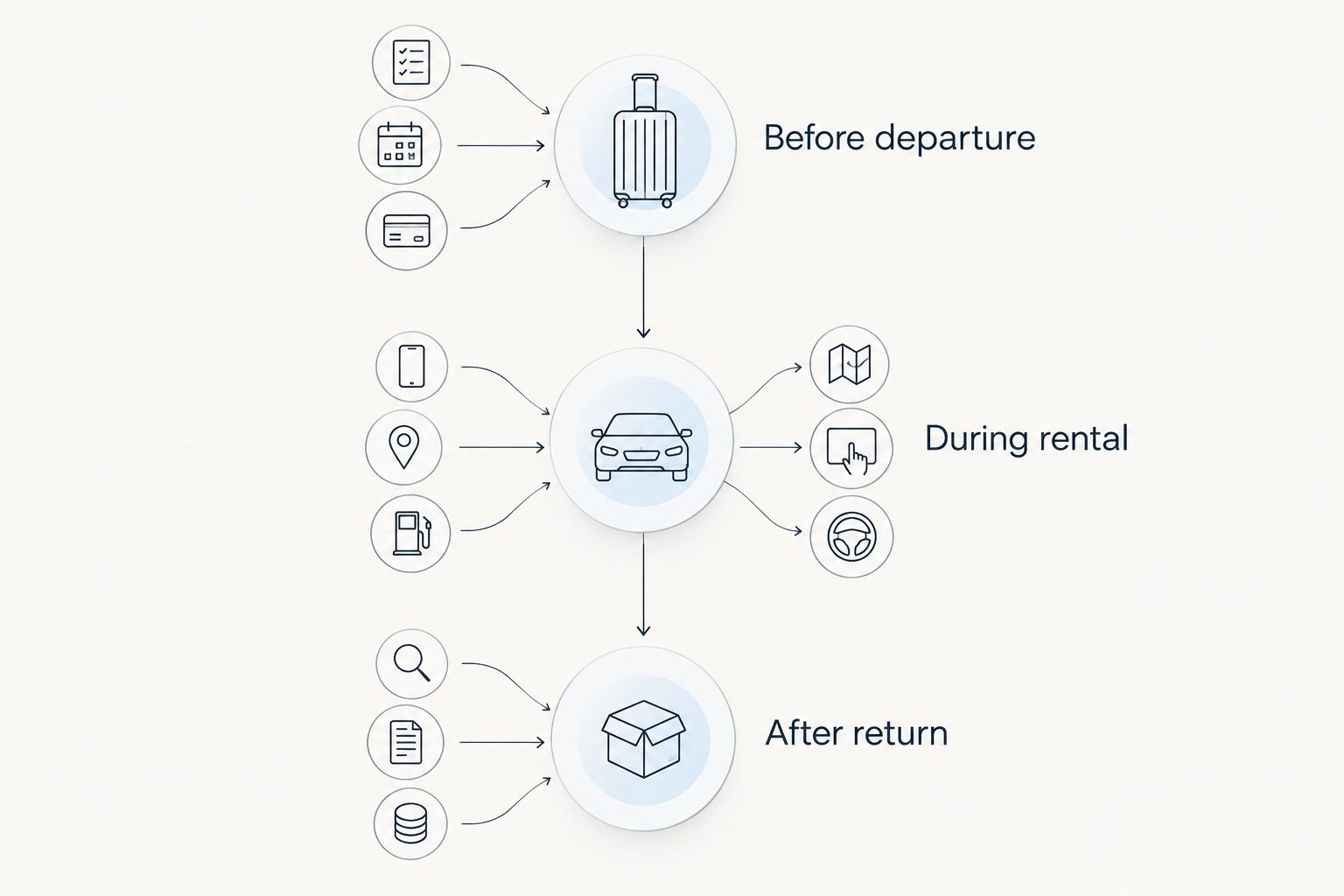
Assign 1 accountable coordinator per booking. Other people can carry out tasks, but the coordinator should know whether the handoff, records, and unresolved issues are complete. This is an operating recommendation, not a staffing claim about a particular company.
Keep driver verification separate from booking convenience
A smooth reservation process does not answer whether the assigned driver checks have been completed. For private rentals, ask who reviews identity documents, who handles inconsistencies, and who decides that an unresolved issue prevents handoff. For Turo bookings, confirm the current platform process and the tasks assigned to the host or manager.
Document appearance alone does not establish that the person presenting it is entitled to rent the vehicle. A written process for detecting forged IDs should sit alongside checks that connect the presented document, the person collecting the car, and the booking record.
Do not ask staff to improvise when information conflicts. Specify who reviews the discrepancy, how the decision is recorded, and how identity information is handled under applicable privacy requirements. Avoid collecting extra personal information simply because a system allows it.
For your 2026 review, ask the manager to explain this workflow without sending you a real renter's sensitive documents. A process explanation should show responsibility without unnecessarily exposing personal data.
Give each city a written operating plan
Use the same responsibility standard in Las Vegas, Bullhead City, and Laughlin. Do not assume a service described for one location automatically includes the same delivery arrangements elsewhere. Ask for the actual scope for your vehicle's base location.
Las Vegas: define the handoff
For a Las Vegas vehicle, agree on the pickup location, delivery responsibility, and return instructions. Ask who communicates location changes and who resolves a missed handoff. If your vehicle also needs owner access, record that time in the shared calendar before accepting another booking.
Bullhead City: define maintenance coordination
For a Bullhead City vehicle, identify who receives maintenance alerts, arranges service, and requests owner approval. Ask how planned work affects existing reservations. The answer should explain both the maintenance task and the booking decision, not just name a service contact.
Laughlin: define return and readiness decisions
For a Laughlin vehicle, identify who receives the car and decides whether unresolved condition issues need escalation. Ask who updates its booking status after return. Returning the keys should not automatically mean the vehicle is ready for its next rental.
Each city needs all these controls; the examples highlight different questions to make the discussion concrete. Drivev3 offers management across all three locations, but request the location-specific duties in your agreement rather than assuming identical logistics.
Review owner statements by channel
Your owner statement should let you follow a rental from its booking record to the amount reported to you. Request separate identification of Turo activity and private-rental activity, along with the expenses and adjustments associated with each vehicle.
Use the rental car management owner-statement guide to frame questions about reconciliation. Ask how the manager explains an adjustment, identifies an unresolved incident, and distinguishes rental activity from money actually received.
Passive income means delegated day-to-day operations, not guaranteed earnings. Booking activity alone does not establish profitability; review the expenses and obligations associated with your vehicle.
For 2026 proposals, compare the written scope and actual terms, not an earnings promise. Drivev3 emphasizes transparent pricing without hidden fees; request its current management terms and the circumstances requiring separate owner approval. Do not assume a service description answers every expense question.
Can the same manager handle both rental channels?
Yes, the same manager can coordinate both channels, but the duties should remain separately documented. A shared team does not make a Turo booking and a private rental the same transaction.
Ask the manager to walk through an extension, a maintenance interruption, and an incident under each channel. Those examples reveal whether responsibilities are clear before you need them.
Should you delegate every vehicle decision?
No, you should define approval boundaries rather than hand over unlimited discretion by default. Specify who decides whether to pause bookings, authorize repairs, or change an agreed handoff.
Direct access to the owners is a verified part of Drivev3's family-owned service. That access supports a practical conversation, but the management agreement still needs to say which decisions stay with you.
FAQ
What should rental car management include?
Rental car management should define booking coordination, delivery and return duties, maintenance coordination, incident handling, and owner reporting. Your agreement should identify which tasks are included and which decisions require your approval.
Can one vehicle be managed for Turo and private rentals?
A proposed dual-channel arrangement needs a shared availability record and separately documented booking workflows. Confirm platform, contract, legal, and insurance requirements before allowing either type of rental.
Does passive income mean I never need to manage anything?
No, passive income here means delegating daily operations rather than guaranteeing profit or eliminating owner decisions. You still need to review statements, understand expenses, and handle the approvals retained in your agreement.
Who should approve repairs on a managed rental car?
Your management agreement should name the repair approver and define the manager's authority. It should also explain how maintenance affects existing bookings and vehicle readiness.
How do I compare Turo management proposals in 2026?
Compare the written duties, approval boundaries, reporting process, and actual contract terms. Ask each provider to explain the same booking-change, maintenance, and incident scenarios.
Can renters book directly on the Drivev3 website?
The website currently directs renters to Turo listings rather than accepting website bookings or payments. Request the actual rental terms before making arrangements.
Are daily, weekly, and monthly rentals handled the same way?
Daily, weekly, and monthly rental periods need clear coordination for extensions, returns, and maintenance. Confirm the terms for the requested period rather than assuming every arrangement works identically.
One last thing
Before handing over the vehicle, ask the proposed manager to explain what happens when a rental extension conflicts with scheduled maintenance. You should hear who decides, who contacts the renter, who updates the calendar, and who records the outcome.
If that answer is unclear, clarify the agreement before the next booking. A specific handoff rule does more for your operation than a broad promise to handle everything.