
Read your rental car management owner statement by matching rental activity to recorded income, checking each deduction against your agreement, and tracing the resulting owner payment to your bank account. Separate money earned during the reporting period from money actually paid out. Your owner payment is not the same as vehicle profit because expenses paid outside the statement still count.
- Rental car management statements should connect bookings, deductions, adjustments, and owner payments—not just show a final balance.
- V3 Rentals suits owners seeking family-owned Turo management with direct access to the owners.
- Match statement entries to booking records and bank deposits before judging vehicle performance.
- Delegated fleet management reduces day-to-day tasks; it does not guarantee passive income or rental profitability.
How do you read a rental car management owner statement?
Follow the money from the booking record to the bank deposit, then account for vehicle expenses separately. For your 2026 review, use the statement, supporting transaction records, and your bank activity together. Each answers a different question.
| Record | Best for | What it cannot establish alone |
|---|---|---|
| Booking record | Checking which rental activity an entry concerns | Whether the owner received the payment |
| Owner statement | Reviewing reported income, deductions, and balances | Whether every vehicle expense is included |
| Bank activity | Confirming money received and its deposit date | Explaining the individual bookings behind a combined payment |
Start with these 3 records before questioning a balance. For a closer look at fee questions, see the guide to Turo fleet management costs.
Why this matters
An owner statement supports a decision: keep the current arrangement, ask for clarification, or change how the vehicle is managed. A payment total alone cannot tell you which decision makes sense.
For your 2026 statement review, distinguish reporting clarity from vehicle performance. A fully explained statement can still show disappointing results; an unexplained statement does not give you enough information to assess those results fairly.
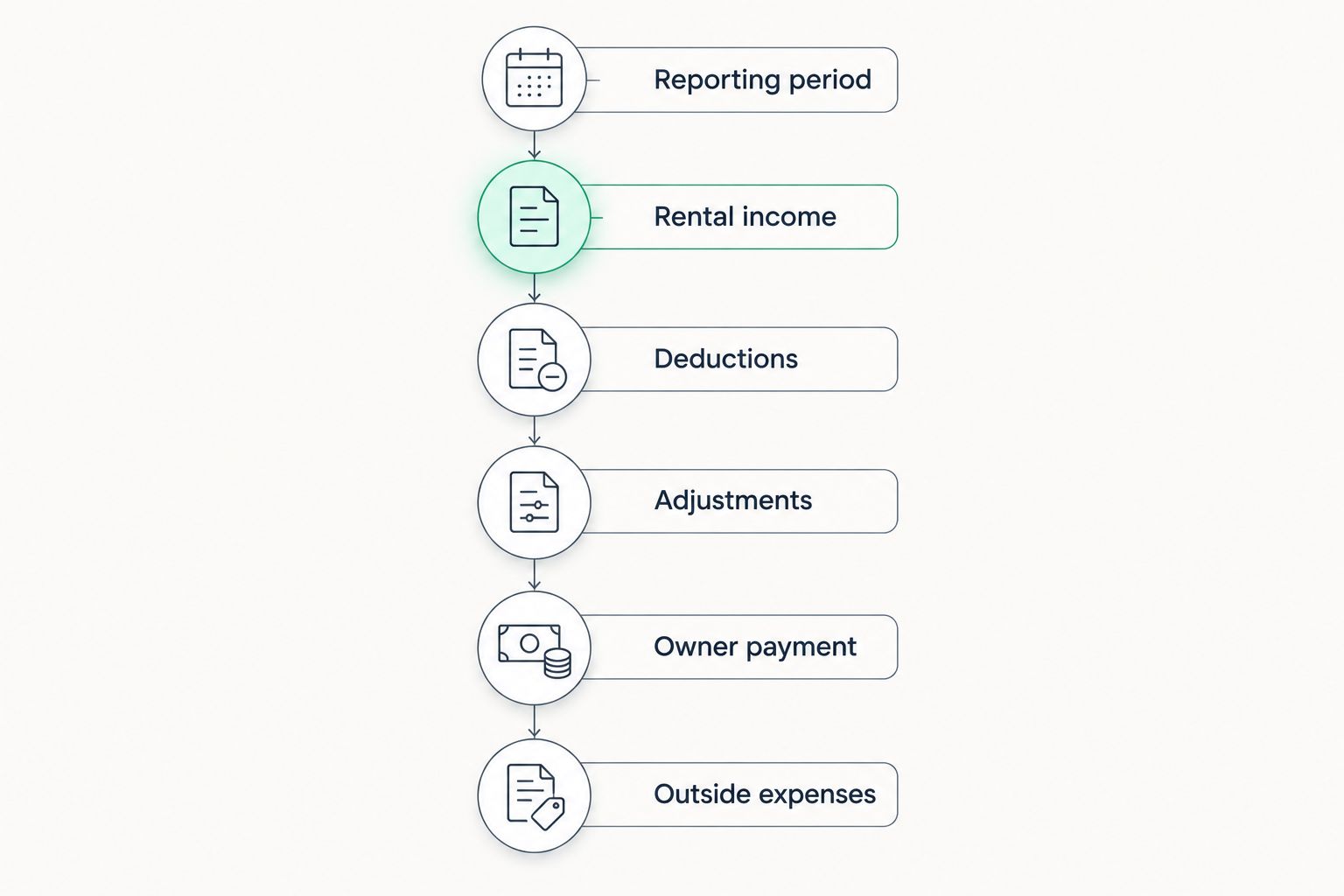
Read the statement in 6 checks
Use the following sequence for each reporting period. Keep questions attached to the relevant entry instead of sending a general request to explain the entire statement.
1. Reporting period
Confirm the statement’s start and end dates, the vehicle it covers, and whether it reports activity by booking date, trip completion, or payment receipt. Ask the manager which timing rule applies rather than assuming the statement follows your calendar.
A rental that crosses a reporting boundary needs particular attention. Establish which period includes its income and whether later refunds or adjustments appear elsewhere.
If you own several vehicles, check the vehicle identifier before reviewing the totals. A fleet-level payment does not replace a vehicle-level explanation. You need to know which vehicle generated each income or expense entry before making decisions about that vehicle.
2. Rental income
Match each income entry to its underlying booking or transaction reference. Check the dates, vehicle, and description, then ask what the income column represents: the guest’s rental charge, a platform payout, or another defined amount.
Do not treat those labels as interchangeable. The statement should make clear whether deductions have already occurred before income reaches the report.
For Turo and private rental activity, ask for a clear distinction between the channels. This is a reconciliation request, not an assumption that both channels use the same payment process or contractual terms.
3. Deductions
Read the management agreement beside the statement. For each management charge, identify the agreed calculation method and the amount to which that method applies.
Check service charges and vehicle expenses separately. Booking coordination, maintenance coordination, and delivery are different activities; your agreement should establish which services are included and which require separate approval or payment.
Do not subtract a charge again if the reported income already excludes it. When a label is unclear, request the calculation behind that entry instead of guessing from the heading.
4. Adjustments
Look for refunds, corrections, reimbursements, and entries carried over from another reporting period. Each adjustment should have a reason and a reference that lets you connect it to the original activity.
Keep a damage-related reimbursement separate from ordinary rental income in your review. Ask which expense or event it relates to before treating it as an improvement in operating performance.
An adjustment is not automatically an error. The question is whether you can trace it and understand its effect on your balance.
5. Owner payment
Locate the statement’s explanation of the amount payable to you. Where opening balances, deductions, adjustments, or retained amounts apply, ask how each contributes to that final figure.
Then match the reported payment to bank activity. Compare the amount and payment reference, allowing for the distinction between the statement date and the date money reaches your account.
If several statement amounts arrive as a combined deposit, request a payment breakdown. If a statement payment arrives in separate deposits, document how those deposits reconcile to the reported total.
6. Outside expenses
Build a separate list of vehicle expenses you pay outside the management statement. Depending on your actual arrangements, your records might include financing, registration, insurance, or repairs paid directly by you.
Use only expenses that actually apply to your vehicle. For an accounting or tax assessment, ask a qualified professional how to treat loan principal, interest, depreciation, and other items rather than treating every cash payment as the same kind of expense.
Review cash received and vehicle profitability separately. The owner payment answers a cash question; a profitability assessment requires a defined treatment of all relevant income and expenses.
Why your owner payment varies
When comparing your 2026 statements, explain the change before judging the manager. Compare periods using the same definitions, then investigate the entries responsible for the difference.
- Rental activity: Check the underlying bookings and completed rental activity rather than relying on the payment total.
- Reporting timing: Establish whether income belongs to the period under the manager’s stated reporting method.
- Management charges: Confirm the agreed calculation and whether its basis changed with rental activity.
- Vehicle expenses: Identify maintenance or other documented expenses charged during the period.
- Refunds and adjustments: Trace corrections and reimbursements to their original transactions.
- Payment timing: Separate an amount reported as payable from money already deposited in your account.
Avoid explaining a change with local demand, a particular event, or a vehicle’s popularity unless the booking records support that explanation. A reason that sounds plausible is not a reconciliation.
How do you compare reporting periods fairly?
Compare the same vehicle, the same income definition, and the same categories of deductions. If the reporting method changed, ask for a reconciliation before drawing a performance conclusion.
Keep a short explanation beside any unusual entry. Your next review becomes more useful when you can distinguish a recurring operating expense from a correction relating to an earlier period.
What should you do when a deduction is unclear?
Ask for the deduction’s description, supporting record, and relevant agreement provision. Request a written explanation of how it affected the owner payment.
Do not assume that an unfamiliar label proves an unauthorized charge. Equally, do not accept a label as a substitute for the agreed calculation.
Does a larger owner payment mean the vehicle earned more profit?
A larger owner payment does not establish higher vehicle profit. Payment timing, adjustments, and expenses paid outside the statement can change the relationship between cash received and operating results.
Use the same accounting approach across periods. Otherwise, your comparison measures a change in recordkeeping rather than a change in performance.
Apply the same checks across all service areas
Owners reviewing 2026 activity in Las Vegas, Bullhead City, and Laughlin need the same core evidence: identifiable bookings, explained deductions, and traceable payments. Ask for location details where they help explain a service or expense; do not assume a location explains a charge by itself.
Las Vegas
For a Las Vegas vehicle, connect any delivery-related entry to the booking and agreed service. Ask which activity the entry covers and whether the statement records the associated income and expense separately.
If your vehicle has both Turo and private rental activity, request identifiable channel records. The city name alone does not explain how the money moved.
Bullhead City
For a Bullhead City vehicle, connect maintenance-related entries to the work performed and the supporting invoice or service record. Confirm how authorization and owner notification work under your actual management agreement.
Separate time out of service from an expense charged to the vehicle. They answer different ownership questions and should not be treated as interchangeable explanations.
Laughlin
For a Laughlin vehicle, connect pickup or delivery entries to their booking references and agreed responsibilities. If the vehicle changes location, ask which recorded transaction explains the movement and any associated charge.
Apply the same documentation standard to a correction or reimbursement. Location detail adds context, but it does not replace a transaction reference.
Choose management that leaves you informed
V3 Rentals is best for owners seeking family-owned rental car management with direct access to the owners. The company manages Turo and private rental vehicles and serves Las Vegas, Bullhead City, and Laughlin.
V3 Rentals emphasizes booking and maintenance coordination, delivery, and transparent pricing without hidden fees. Before agreeing to management, request the actual service terms and ask how those responsibilities will appear in your owner reporting.
The benefit is delegated day-to-day work. The limitation is that delegation does not remove your financial responsibilities or guarantee rental profitability; you still need to understand the agreement and review the records.
When discussing rental car management with V3 Rentals, bring a vehicle summary and the reporting questions that matter to you. Ask to see how income, deductions, and payments are explained before deciding whether the arrangement fits your ownership goals.
What to send when a statement does not reconcile
Send a focused question, not an unsupported accusation. Identify the reporting period, vehicle, transaction reference, and the specific entry you cannot match.
Attach the relevant booking confirmation, invoice, or bank record if you have it. Explain whether your question concerns the calculation, the reporting period, or the payment itself; those issues need different answers.
For your 2026 records, keep the original statement and any corrected version together. Record the explanation alongside the affected entry so the same question does not resurface during your next review.
Close the issue only when the explanation connects back to the records. A reassuring conversation helps, but a traceable correction gives you something useful for future ownership decisions.
FAQ
How do I read a rental car management owner statement?
Read a rental car management owner statement by matching rental income to booking records, checking deductions against your agreement, and tracing the owner payment to your bank account. Review expenses paid outside the statement separately.
Is my owner payment the same as my vehicle profit?
Your owner payment is not the same as vehicle profit. Expenses outside the statement and differences in payment timing require a separate review before you assess profitability.
What should I ask about a management charge?
Ask how the management charge was calculated and which agreement provision authorizes it. Confirm whether its calculation uses an amount before or after other deductions.
Why does my bank deposit differ from my owner statement?
A bank deposit and an owner statement answer different questions: one records cash received, while the other reports activity and balances. Request a payment breakdown to identify whether timing, combined payments, or another documented entry explains the difference.
Should Turo and private rental income be identified separately?
Ask for Turo and private rental income to be identifiable in the supporting records. Distinguishing the channels helps you trace bookings, deductions, and payments without assuming both use the same process.
What records should support a maintenance deduction?
Request the invoice or service record supporting a maintenance deduction and check it against your management agreement. Confirm the vehicle, work description, and applicable authorization process.
Does delegated rental management guarantee passive income?
Delegated rental management does not guarantee income or profitability. It transfers agreed day-to-day tasks while leaving the owner responsible for understanding the financial arrangement and reviewing results.
One last thing
Ask a manager to walk through an anonymized sample statement before you sign, rather than waiting for your first payment. A clear sample lets you test whether you can follow a booking through deductions to the owner balance without exposing another owner’s information.
Choose understandable reporting, not just an attractive income projection. If you cannot explain how the payment was calculated, you are not ready to use that statement to judge the vehicle.