
The person authorized by your signed Turo management agreement approves repairs: you, the management company within delegated limits, or both under a defined approval process. Permission to arrange repairs is not automatically permission to authorize every repair or charge you for it; the agreement should separately address spending authority, payment responsibility, and emergency action.
- Your signed agreement should identify who approves repairs, who pays, and what happens when you cannot respond.
- Choose a Turo management company with written repair limits, documented approvals, and a clear emergency process.
- Drivev3 offers family-owned Turo management for owners seeking delegated booking and maintenance coordination.
- Repair approval does not establish Turo reimbursement, insurance coverage, or responsibility for damage.
Why this matters
Delegating vehicle operations should reduce your daily workload without leaving repair decisions undefined. Before choosing a family-owned vehicle management service, ask to see the actual repair-approval language rather than relying on a general promise to handle maintenance.
For an agreement you sign in 2026, focus on the handoff between identifying a problem and authorizing work. That is where your manager needs clear instructions, your repair shop needs a decision, and you need a record of what you accepted.
Who approves repairs in a Turo management agreement?
Your agreement should name the decision-maker for each category of work. Do not treat the owner, manager, repair shop, and Turo as interchangeable: authorizing work, completing work, and deciding a reimbursement request are different functions.
Use this comparison to choose the approval structure you want. These are proposed contract approaches, not statements about any company's current terms.
| Approval approach | Who authorizes work | Best for | Advantage | Limitation |
|---|---|---|---|---|
| Owner approval | You approve each repair before work starts | Owners who want direct spending control | You review the scope before committing | Work waits for your response unless an exception applies |
| Delegated approval | The manager approves work within written limits | Owners who want routine decisions handled | Defined work proceeds without a separate owner decision | Broad wording gives the manager more discretion |
| Shared approval | The manager handles specified work; you approve exceptions | Owners balancing delegation and oversight | Authority follows the repair category and limit | Unclear categories create disputes over who decides |
Choose the narrowest delegation that still lets your manager perform the work you want handled. A spending limit alone is not enough. Specify what the limit covers, how related repairs are grouped, and when a new estimate requires fresh approval.
For your 2026 agreement, make the approval method explicit. Name the email address, messaging channel, or other written process that counts as authorization, and identify anyone allowed to approve on your behalf.
Owner approval: direct control before work starts
An owner-approval arrangement gives you the decision on proposed repairs. Ask for wording that requires your written authorization before the manager instructs a shop to proceed, except for separately defined emergency actions.
This approach is best for owners who want to review repair scope personally. Its advantage is direct oversight; its drawback is that the decision remains on your plate even though someone else coordinates the repair.
Ask the manager to send a decision-ready request, not simply a message saying the vehicle needs attention. You should receive the reported problem, proposed work, supporting documentation, estimate, and any decision needed about scheduled trips.
Specify what happens when you decline. Your agreement should distinguish declining a repair from authorizing the vehicle's return to rental service; those are separate decisions and should have separate records.
Delegated approval: authority within written boundaries
Delegated approval lets a manager authorize specified work without contacting you each time. Define that authority by task, spending boundary, and circumstances rather than using an open-ended phrase such as necessary maintenance.
This approach is best for owners who want defined routine decisions handled. It reduces individual approval requests, but the trade-off is less involvement before authorized work begins.
Have the agreement distinguish an inspection from a repair. Permission to investigate a warning light should not be written as unrestricted permission to replace whatever the shop recommends afterward.
Also define whether the limit applies to an individual repair, a related repair event, or another agreed grouping. Ask for language preventing related work from being split into separate approvals simply to stay within the boundary.
Shared approval: routine work delegated, exceptions reserved
Shared approval separates work the manager can authorize from work that comes back to you. It is best for owners who want operational help while retaining control over exceptions.
The benefit is a clear division of responsibilities. The limitation is that poorly defined categories leave room for disagreement: a manager and owner might not mean the same thing by routine, urgent, or major.
Write down the categories instead of assuming they are obvious. For example, decide whether scheduled maintenance, diagnosis, damage repair, and elective improvements follow the same process or different approval paths.
Treat this as a drafting checklist, not a description of your current contract. Your signed terms must establish which tasks are delegated and which remain yours.
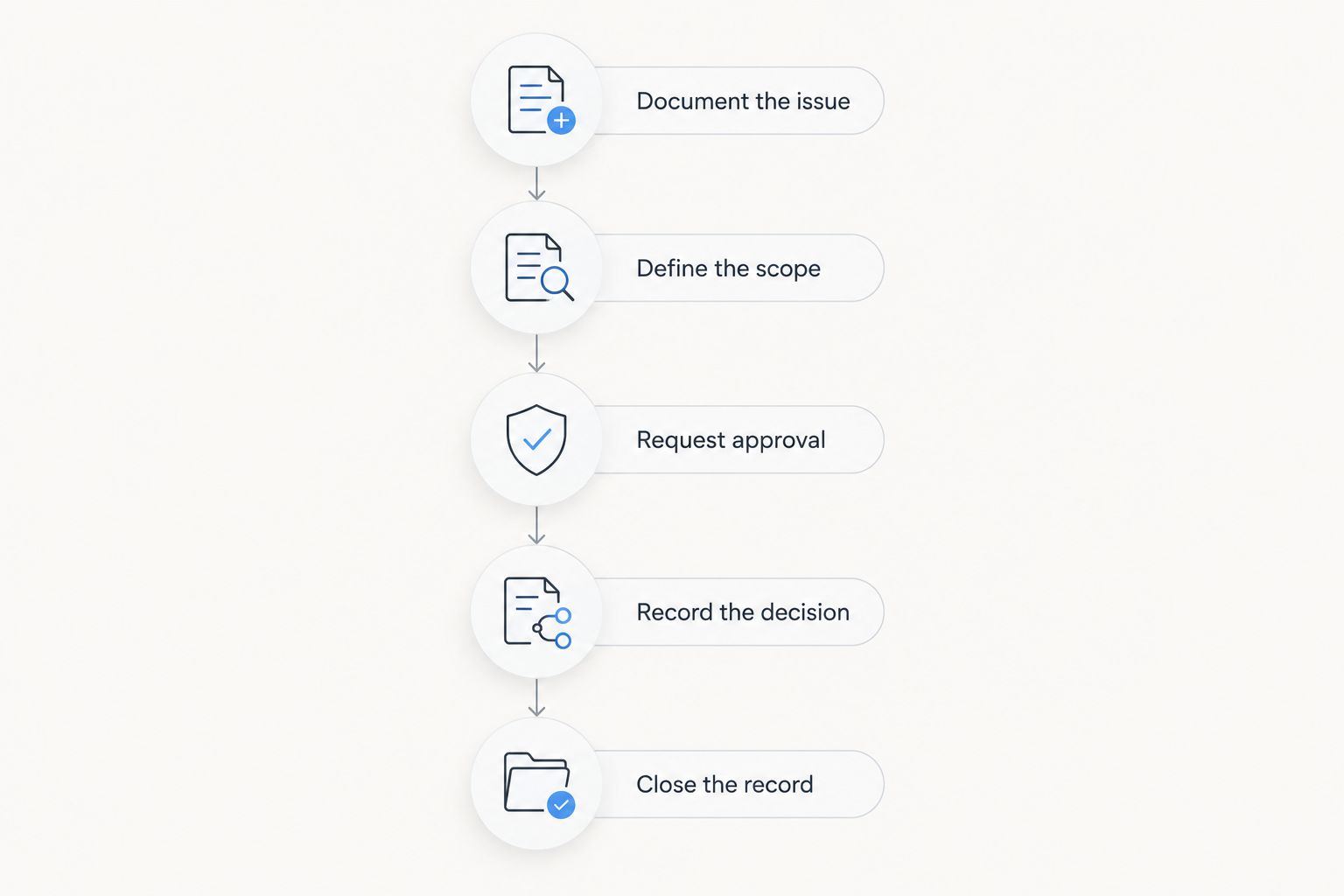
How should a repair request move from diagnosis to approval?
A useful approval process gives you enough information to decide and leaves a record for everyone involved. Ask your prospective manager to walk through the following sequence before you sign.
- Document the issue. Record the reported symptom, inspection findings, and relevant photos. Separate observed damage from assumptions about its cause.
- Define the scope. Identify the proposed work and distinguish diagnosis from the repair itself. Ask which items are required for the proposed repair and which are optional recommendations.
- Request approval. Send the estimate and scope through the agreed channel. Identify whether the request falls within delegated authority or needs your decision.
- Record the decision. Save your authorization, rejection, or request for changes. If the scope changes, apply the agreement's process for additional approval.
- Close the record. Retain the final invoice, work description, and any follow-up recommendations. Separately document the decision about returning the vehicle to service.
The sequence matters because an estimate, an approval, and a final invoice serve different purposes. A final invoice records completed work; it should not be the first notice that you were expected to authorize it.
Why repair-approval authority varies
Repair-approval authority should reflect the responsibilities you actually delegate. Use these factors to examine the agreement, rather than assuming every Turo management company follows the same rules:
- Management scope. Booking coordination, maintenance scheduling, and repair authorization are different responsibilities. Specify which ones the manager accepts.
- Type of work. Scheduled maintenance, diagnostic work, damage repairs, and optional improvements need clear categories if they follow different rules.
- Spending boundaries. Define what counts toward the authorization limit and what requires another decision.
- Owner availability. Name a backup contact and an escalation process instead of treating an unanswered message as permission.
- Emergency instructions. Separate immediate protective action from authorization for a complete repair.
- Payment arrangements. Identify who contracts with the shop and how approved expenses are handled between owner and manager.
Recheck these boundaries when renewing in 2026. If your manager's responsibilities change, update the written authority rather than relying on a conversation that neither party can later reconstruct.
What happens if you cannot answer a repair request?
Your agreement should define the next step when you cannot respond. Ask it to identify the backup decision-maker, the escalation channel, and which actions remain permitted while approval is pending.
Do not leave silence undefined. If you want affirmative written approval, say so; if you want limited delegated action during your absence, specify its boundaries.
A missed message should not force the manager to guess whether you intended approval. Before traveling or becoming unavailable, confirm who can make decisions and how that person receives the supporting documents.
Can a manager authorize an emergency repair without asking you?
A manager's emergency authority depends on the agreement and applicable requirements; do not assume a general management appointment answers the question. Have the contract distinguish protecting a vehicle from further damage from approving the complete repair.
Ask for a written emergency process covering notification, documentation, permitted actions, and the point at which owner approval becomes necessary. Avoid wording that labels every booking disruption an emergency.
Keep safety decisions separate from spending decisions. Your instructions should not require a manager to continue offering a vehicle for rental while an unresolved safety concern awaits your response.
Does approving a repair mean Turo or insurance pays?
Approving a repair does not establish reimbursement or coverage. Treat your authorization to proceed, the responsibility for payment, and any claim decision as separate questions.
Before authorizing work connected to reported damage, ask what documentation needs to be preserved and which applicable platform or coverage requirements need review. Do not assume a manager's confidence about recovery is a coverage decision.
Keep the repair record connected to the incident record without treating them as identical. The guide to Turo fleet management damage documentation addresses the evidence side of that handoff.
Apply the same approval standard across all three cities
For Las Vegas owners, ask how a pending repair decision affects booking coordination and delivery arrangements. Name who communicates operational changes while you review the proposed work; do not let that responsibility disappear between the manager and owner.
For Bullhead City owners, ask who coordinates the shop appointment, receives the estimate, and collects the completed maintenance record. The approval process should identify the person responsible for each handoff rather than stopping at permission to schedule service.
For Laughlin owners, ask how repair decisions connect with vehicle delivery and return logistics. Make the authorization route clear even when the person arranging a handoff is not the person empowered to approve repairs.
Drivev3 is a fit for owners seeking family-owned Turo management with direct access to the owners. Its stated services include booking and maintenance coordination and delivery across Las Vegas, Bullhead City, and Laughlin; ask for its actual repair-approval terms before deciding whether that service fits your ownership preferences.
What should you ask before signing in 2026?
Ask Drivev3 to explain who authorizes repairs, how you receive estimates, and what happens when the work changes. Request transparent written pricing without hidden fees, including an explanation of how management charges and approved repair expenses are distinguished.
The service benefit is delegated coordination and direct owner access. The boundary to verify is repair discretion: a description of maintenance coordination does not, by itself, establish the manager's spending authority.
Bring a sample situation to the conversation: the shop finds additional work after you approve the original scope. Ask who contacts you, whether work pauses, and where the revised authorization is saved.
If you want passive income, define that as delegating day-to-day operations—not a promise of profit or the removal of every ownership decision. Repairs, contract review, and decisions outside delegated limits still need an assigned decision-maker.
Clarify your repair approval terms
Discuss management responsibilities and written repair authority for your vehicle.
FAQ
Who approves repairs when I hire a Turo management company?
The approval authority should be stated in your signed management agreement. It can reserve decisions for you, delegate specified work to the manager, or divide authority by repair category and spending limit.
Can I require written approval before any repair?
You can request an owner-approval clause before signing. Have the agreement separately address emergency actions and what happens when you cannot respond.
Does maintenance coordination include permission to approve repairs?
Maintenance coordination does not, by itself, define repair-approval authority. Ask the agreement to distinguish scheduling, diagnosis, authorization, and payment responsibility.
What if the shop finds more work after I approve the estimate?
Additional work should follow the revised-approval process specified in your agreement. Define when a changed scope or estimate requires another written decision.
Does repair approval guarantee reimbursement through Turo?
Repair approval does not guarantee reimbursement through Turo. Authorization, payment responsibility, and any claim decision are separate matters governed by the relevant terms.
What should I ask Drivev3 about repair approvals?
Ask Drivev3 who authorizes repairs, what limits apply, how approvals are documented, and what happens in an emergency. Request the actual written terms for your vehicle and management arrangement.
One last thing
Before signing in 2026, ask to see the approval message you would receive for a real repair decision, with private details removed. A sample request shows whether the process gives you a clear scope, supporting evidence, and an explicit decision—not just a notification that work has already happened.
The best approval clause is one you can use when a repair is waiting. Make sure your agreement answers who decides, what they can authorize, and where that decision is recorded.