
In Turo fleet management, your written management agreement should assign who can pause a car, approve work, and authorize its return; ownership alone does not settle the manager’s operating authority. Give the manager permission to stop new bookings when a safety concern needs investigation, while separately defining your repair-approval rights. A car should return only after the reason for the pause is resolved and any applicable platform requirements are satisfied—not simply because someone wants the calendar open.
- Turo fleet management agreements should separate booking pauses, repair approval, and return authorization.
- Give managers clear authority to pause bookings while a safety concern is investigated.
- Drivev3 suits owners seeking family-owned Turo fleet management with direct access to the owners.
- Require a documented reason, next action, and return condition for every offline period.
Why this matters
Delegating bookings and maintenance does not answer every ownership question. You still need to know what happens when a manager identifies a problem, a repair needs approval, or you want the vehicle back for personal use.
Agree on decision rights before handing over the keys. For a 2026 management agreement, treat taking a car offline as a defined process rather than an informal conversation. That protects your ability to understand the decision without making every operational step wait for your reply.
Drivev3 provides family-owned Turo fleet management in Las Vegas, Bullhead City, and Laughlin, with direct access to the owners. That service model suits owners who want to delegate daily coordination while retaining a clear point of contact; it does not replace the need for written approval rules.
Turo fleet management: who decides when a car stays offline?
The agreement should distinguish 3 decisions: pause bookings, approve work, and authorize return. These decisions need not belong to the same person. Your manager can identify a concern and stop new bookings without automatically receiving permission to approve every repair.
Use the following as an agreement checklist, not a statement of any provider’s existing terms.
| Decision | Recommended responsibility | What to put in writing |
|---|---|---|
| Pause new bookings | Manager for a safety concern; owner for agreed personal use | Reasons that permit a pause and how the owner is notified |
| Approve repairs | Owner, except for work expressly preauthorized | Scope of authority, approval method, and escalation contact |
| Coordinate work | Manager where included in the service scope | Who schedules, transports, follows up, and records progress |
| Authorize return | Named person after the return conditions are met | Evidence required and any platform restrictions to resolve |
The distinction matters when you disagree. An owner approving a repair does not establish that the repair is complete. A manager finishing a calendar update does not establish that the vehicle is ready for a guest.
For your 2026 agreement review, ask each party to explain the same scenario: a concern appears before the next trip, and the owner is unreachable. The answers should match the written process.
Safety pauses: stop first, then establish the next action
Authorize the manager to pause new bookings while a credible safety concern is investigated. Make notification a requirement, but do not make reaching you a prerequisite for that protective pause.
The next action must be specific. Ask whether the vehicle needs an inspection, whether an existing booking needs attention, and who is responsible for obtaining the information needed to decide what happens next. Avoid a vague instruction to keep the car offline until further notice.
This recommendation is not permission to approve unrestricted spending. Separate the authority to prevent a new handoff from the authority to commission work. Your agreement should explain what happens if resolving the concern requires an expense you have not approved.
A useful pause notice states the observed issue without presenting an unconfirmed diagnosis as fact. A warning light, an unusual noise, or visible damage is an observation; the cause needs appropriate assessment.
Repair pauses: separate approval from completion
When a repair is needed, decide who gathers the assessment and who authorizes the work. Ask for a description of the proposed work and a written record of your approval through the agreed communication channel.
Then define what closes the repair pause. An appointment confirmation is not completion evidence, and completion evidence should address the reason the vehicle stopped accepting bookings. Require the manager to record any unresolved issue before requesting a return decision.
If damage is involved, keep the condition record separate from assumptions about responsibility or coverage. The Turo fleet management damage documentation guide addresses the records owners should discuss with a manager.
For an existing agreement reviewed in 2026, check whether repair authorization and return authorization appear as separate responsibilities. If the document only says the manager handles maintenance, ask for the decision process to be made explicit.
Owner-requested pauses: plan personal use before accepting trips
If you want to use your own vehicle, agree on the notice process before a scheduling conflict occurs. State who receives the request, who checks existing commitments, and who confirms the blocked dates.
Do not treat a personal-use request as an automatic cancellation instruction. Ask the manager to explain how the request interacts with accepted trips and the applicable booking terms before changing the calendar.
Also define the handback. Agree on where you collect and return the vehicle, how its condition is recorded, and who confirms readiness afterward. Your ownership rights and your management arrangement need to work together in a usable process.
Which approval model fits your ownership style?
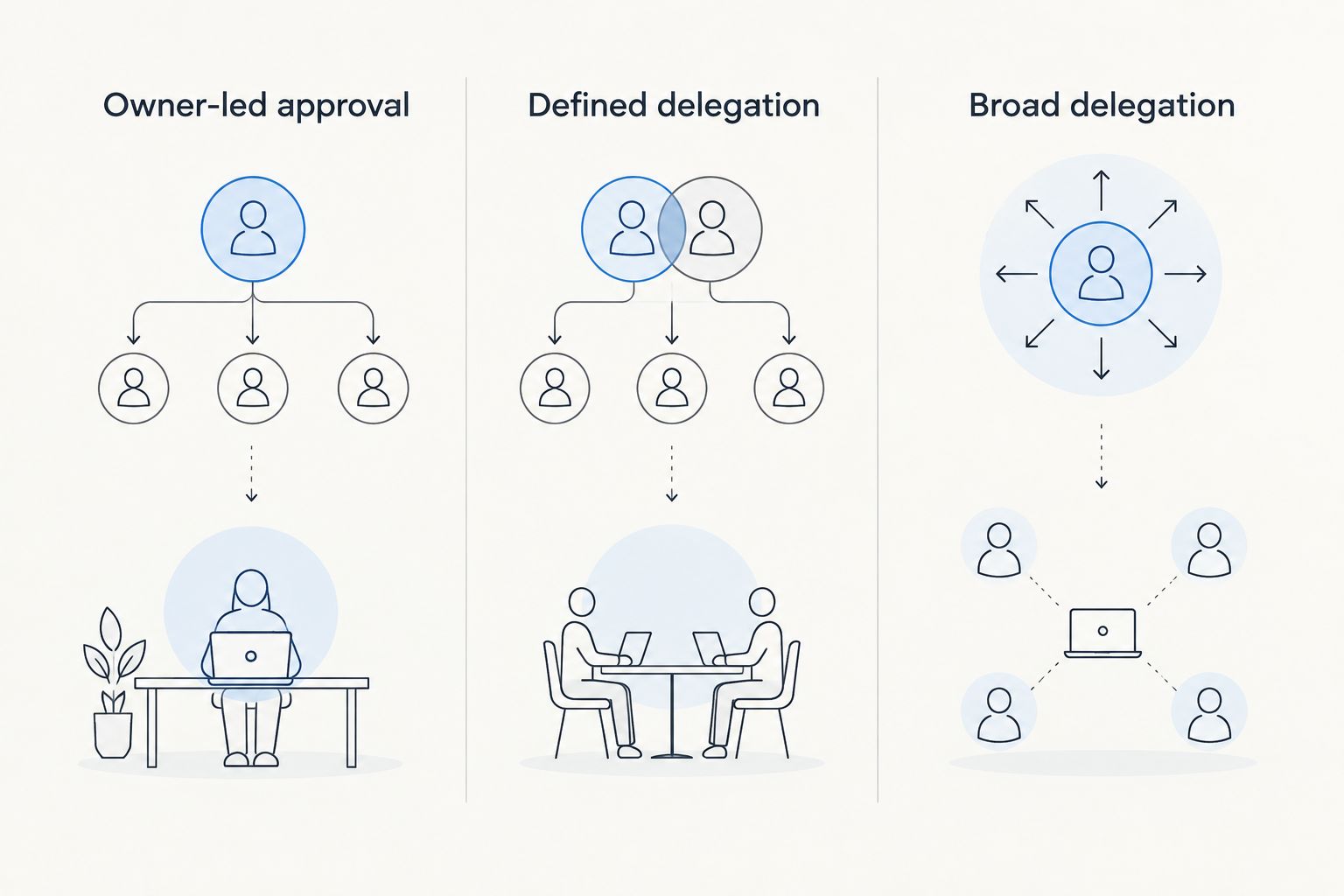
Choose an approval model based on how much responsibility you want to delegate, not just how often you want updates. These are proposed arrangements to discuss—not named service packages or confirmed Drivev3 contract options.
| Approval model | Best for | Benefit | Trade-off |
|---|---|---|---|
| Owner-led approval | Owners who want close control over nonurgent decisions | Direct involvement in repair and scheduling choices | Requires you to respond when approval is needed |
| Defined delegation | Owners who want routine work handled within written limits | Manager can act inside an agreed scope | Limits need enough detail to avoid disputes |
| Broad delegation | Owners comfortable assigning wider operating authority | Fewer routine decisions return to you | Requires careful reporting and clear exclusions |
Defined delegation is the practical starting point to discuss: let the manager handle specified work, reserve other decisions for you, and spell out exceptions. Its weakness is an incomplete scope; an undefined phrase such as routine maintenance leaves room for conflicting expectations.
Owner-led approval suits active oversight, but the agreement needs a fallback when you cannot respond. Broad delegation suits less day-to-day involvement, but you still need records showing why the car stayed offline and what authorized its return.
Why offline decisions vary
Offline authority should reflect the actual reason for the pause. Use these 5 factors when agreeing on the process:
- Vehicle condition. A safety concern needs a different response from a planned personal-use request.
- Written authority. The management agreement should say which decisions are delegated and which remain yours.
- Repair scope. Permission to arrange an assessment should not silently become permission to approve all work.
- Existing commitments. A calendar change needs to account for accepted trips and the terms that govern them.
- Return conditions. The person reopening the calendar needs to know what evidence closes the original issue.
Avoid using demand as the deciding factor for an unresolved condition concern. An attractive booking does not resolve the reason a vehicle was paused.
Likewise, avoid making every pause permanent until you personally inspect the car unless that is genuinely the arrangement you want. Set a clear approval route that matches your desired involvement.
What should an offline update include?
Require 4 fields in every offline update: reason, authority, next action, and return condition. These fields explain the decision without requiring a long message thread.
- Reason: What was observed, when it was identified, and why bookings were paused.
- Authority: Who made the decision and which agreed responsibility allowed it.
- Next action: What happens next, who handles it, and whether owner approval is required.
- Return condition: What must be resolved or documented before the vehicle can accept trips again.
Add the time of the next update when it is agreed, rather than accepting an unsupported completion promise. If an inspection or repair schedule changes, the update should explain the new next action.
Use this format throughout 2026 so you can compare decisions consistently. The purpose is accountability, not paperwork for its own sake: you should be able to identify what is keeping the car offline and who can move the decision forward.
Does the process change across the three service areas?
The authority framework should remain clear in Las Vegas, Bullhead City, and Laughlin. Confirm the local arrangements for the vehicle rather than assuming a process agreed for one location applies unchanged elsewhere.
Las Vegas
For a Las Vegas vehicle, ask where inspections and handoffs occur during an offline period. Confirm who coordinates delivery changes and communicates about an affected trip; booking coordination and repair approval are separate responsibilities.
Bullhead City
For a Bullhead City vehicle, ask who arranges maintenance and how progress reaches you. Identify the person responsible for following up when the next step is waiting on an assessment rather than your approval.
Laughlin
For a Laughlin vehicle, ask who controls delivery and return arrangements after an offline period. Confirm who checks that the vehicle is ready before a handoff is arranged, rather than treating transport as proof of readiness.
Drivev3 coordinates bookings, maintenance, and delivery across these service areas. Ask the owners to put the proposed offline authority, approval boundaries, and communication process into your actual agreement.
Discuss your vehicle management terms
Ask who can pause bookings, approve work, and authorize your vehicle’s return.
Can my manager keep the car offline without my approval?
A manager’s authority to keep a car offline should be defined in your agreement, with a separate route for unresolved safety or platform restrictions. Ask what triggers notification, when the decision is reviewed, and how you challenge a nonurgent pause.
Do not accept a process that depends entirely on verbal understanding. The written terms should identify the decision-maker and escalation route when you disagree.
Can I reopen bookings while a repair is pending?
A pending repair is not evidence that the reason for the pause has been resolved. Ask the responsible person to confirm the vehicle’s condition and any applicable requirements before authorizing a return.
If the work is unrelated to the pause, document that distinction rather than assuming every open task requires the same response. The return decision should address the actual reason bookings stopped.
Who handles a trip affected by an offline decision?
Your agreement should assign guest communication and booking-change coordination to a named role. Keep that responsibility separate from the owner’s decision about repairs, and require the process to follow the applicable booking terms.
For your 2026 review, confirm the backup contact as well. A defined escalation route is more useful than an expectation that everyone will always answer immediately.
FAQ
Who has the final say when my Turo car stays offline?
Your management agreement should assign offline authority, while unresolved safety concerns and applicable platform restrictions still need to be addressed. Separate the right to pause bookings from the authority to approve repairs and authorize return.
Does owning the car mean I approve every calendar change?
Owning the car does not explain which operating decisions you have delegated. State your approval rights and the manager’s authority in the written agreement.
What is the best approval model for a hands-off owner?
Defined delegation is a practical starting point for an owner who wants fewer routine decisions without granting unrestricted authority. Specify the permitted work, exclusions, reporting process, and fallback contact.
Can a fleet manager approve repairs without asking me?
Repair approval should follow the authority expressly granted in your management agreement. Give the manager a clear scope and require separate approval for work outside it.
Does passive income mean I never need to make decisions?
Passive income in this context means delegating day-to-day operations, not eliminating owner decisions or guaranteeing profit. You still need an agreed process for repairs, personal use, and exceptions.
Can I take my vehicle back for personal use whenever I want?
Personal-use requests need to follow your agreed notice process and account for accepted trips. Confirm the collection, return, condition-recording, and calendar steps before making plans.
What should I ask before hiring a Turo fleet manager?
Ask who pauses bookings, who approves work, and who authorizes return. Then request a written example of how the manager handles a concern when you cannot be reached.
One last thing
Ask for the return rule before discussing the pause rule. Knowing who can stop bookings is only half the decision; you also need to know what ends the offline period.
Before signing in 2026, ask the manager to walk through an unresolved condition concern, a repair awaiting approval, and a personal-use request. If the answer identifies a responsible person, a next action, and a clear return condition in each case, you have a process you can evaluate—not just a promise to handle everything.