
Instead of manually chasing booking details and delivery messages, use a written booking-to-handoff workflow for car rental delivery in Las Vegas: book through the linked Turo listing, confirm the delivery arrangement, and document the handoff. For vehicle owners, the same workflow defines what your manager handles and which decisions still need your approval.
- For car rental delivery Las Vegas searches, confirm the handoff location before treating delivery as arranged.
- Drivev3 suits owners seeking family-owned Turo management with direct access to the owners.
- Renters follow the website’s links to Turo; the website does not take bookings or payments.
- Use a written delivery plan in Las Vegas, Bullhead City, and Laughlin.
Why this matters
A confirmed rental and a confirmed delivery arrangement are separate checkpoints. A booking does not answer where the vehicle will meet you, who can receive it, or how a location change gets approved.
Drivev3 manages Turo and private rental vehicles and coordinates bookings, maintenance, and delivery. Its renter-facing website currently directs you to Turo listings rather than taking reservations or payments itself.
Drivev3 is best for vehicle owners seeking family-owned Turo management with direct access to the owners. Delegating daily operations does not guarantee income or remove ownership decisions; it gives those decisions a defined route.
Use this 2026 workflow to keep booking details, owner approvals, and delivery instructions aligned. It separates the renter’s reservation from the manager’s operating plan without promising a particular delivery location or contract term.
Before you start
- Renter materials: Have access to the relevant Turo listing and booking account, your intended dates, the proposed delivery address, and the receiving person’s details. Check the actual booking requirements before committing.
- Owner materials: Have the vehicle’s operating information, maintenance status, personal-use restrictions, and management agreement ready. Identify who approves repairs, delivery changes, and other exceptions.
- The delivery gotcha: A street address alone is not a handoff plan. Confirm the permitted meeting point, property access, receiving procedure, and return arrangement before dispatch; do not assume a hotel entrance or airport curb is authorized.
For your 2026 planning sheet, use 3 checkpoints: booking, dispatch, and return. Identify 2 contact roles: the receiving renter and the operational coordinator. Keep 1 written handoff plan so changes do not live in separate messages.
Those are workflow recommendations, not platform requirements. Your booking terms and management agreement control the actual arrangement.
Set up the booking record
Start with the reservation, not the delivery promise. The following bold labels are suggested fields for your own worksheet, not names of Turo buttons or settings.
- Record the booking route. Follow the website’s link to the relevant Turo listing and complete the booking through Turo’s current process. Do not treat a website inquiry as a completed reservation.
- Enter the trip details. Record the vehicle, trip dates, booked start and end times, and reservation reference. Copy confirmed information rather than an earlier inquiry or draft itinerary.
- Record the rental period. Ask about daily, weekly, or monthly arrangements as appropriate. Confirm the actual terms for your chosen period instead of assuming that a longer trip automatically changes them.
- Confirm responsibility. Owners should identify who monitors booking messages and who handles exceptions. Renters should know which booking channel to use when their plans change.
- Resolve conflicting details. If a message names a different vehicle, time, or location from the reservation, ask for clarification before delivery preparation begins.
Expected result: You have a confirmed booking record that identifies the trip and the responsible coordinator. Delivery remains a separate item until the meeting point and handoff procedure are agreed.
For an owner, this distinction prevents an inquiry from becoming an operational commitment before the reservation is settled. For a renter, it makes clear which confirmation to check before arranging the rest of the journey.
Configure the delivery plan
A useful delivery plan tells both parties exactly where to meet and what happens if access fails. Apply the same standard in Las Vegas, Bullhead City, and Laughlin rather than carrying instructions from one city into another.
- Enter the meeting point. Write the complete address and the specific permitted handoff area. For a hotel or other managed property, confirm access with the relevant property representative.
- Agree on the handoff time. Compare the proposed meeting time with the reservation. If they differ, resolve the booking implications through the appropriate channel before treating the new time as confirmed.
- Identify the receiver. Confirm who will receive the vehicle and follow the booking’s identity and handoff requirements. Do not substitute a concierge, colleague, or family member without checking the applicable rules.
- Document delivery terms. Request the actual delivery, cancellation, waiting, parking, and return terms that apply. Record the answer; do not infer terms from a general description of the service.
- Define the fallback. Agree on how to communicate if the receiving person is delayed or the meeting point becomes inaccessible. Any replacement location needs confirmation before dispatch changes.
Expected result: Both sides can describe the same location, time, receiving procedure, and fallback without interpreting an unfinished message thread.
Location details to settle in each city
| City | Confirm before dispatch | Owner decision to clarify |
|---|---|---|
| Las Vegas | The exact hotel, residence, or other proposed meeting point and its access rules | Who approves a change if the original handoff point cannot be used |
| Bullhead City | The full address, receiving contact, and permitted vehicle handoff area | Who handles delivery coordination when the owner is elsewhere |
| Laughlin | The property entrance or other agreed meeting point and receiving procedure | Who approves a different return location or collection arrangement |
This 2026 checklist does not establish permission to deliver at any property. A requested location is not an approved location. Ask for a clear answer before building travel or dispatch plans around it.
Configure owner approvals and dispatch
Delivery coordination should not hide unresolved maintenance or permission questions. Owners need a clear boundary between routine work delegated to the manager and decisions retained under the management agreement.
- Check vehicle readiness. Confirm that maintenance concerns, cleaning needs, and reported vehicle issues have been addressed before dispatch. If a concern is unresolved, pause and obtain the appropriate decision.
- Set approval boundaries. Identify who authorizes repairs, scheduling exceptions, personal-use changes, and delivery adjustments. Use the actual agreement rather than assuming the manager has unlimited authority.
- Confirm the dispatch record. Put the booking reference, meeting point, receiving contact, and agreed instructions together. Remove superseded directions so the person delivering the vehicle follows the current plan.
- Check the return plan. Confirm the expected return location, timing, and communication procedure before the vehicle leaves. An outbound delivery address does not automatically define the return arrangement.
- Release the vehicle. Dispatch only after the booking, readiness check, and delivery instructions agree. If something changes, update the plan before proceeding.
Expected result: The coordinator has a usable dispatch record, and the owner knows which decisions require approval. The renter receives instructions tied to the actual reservation.
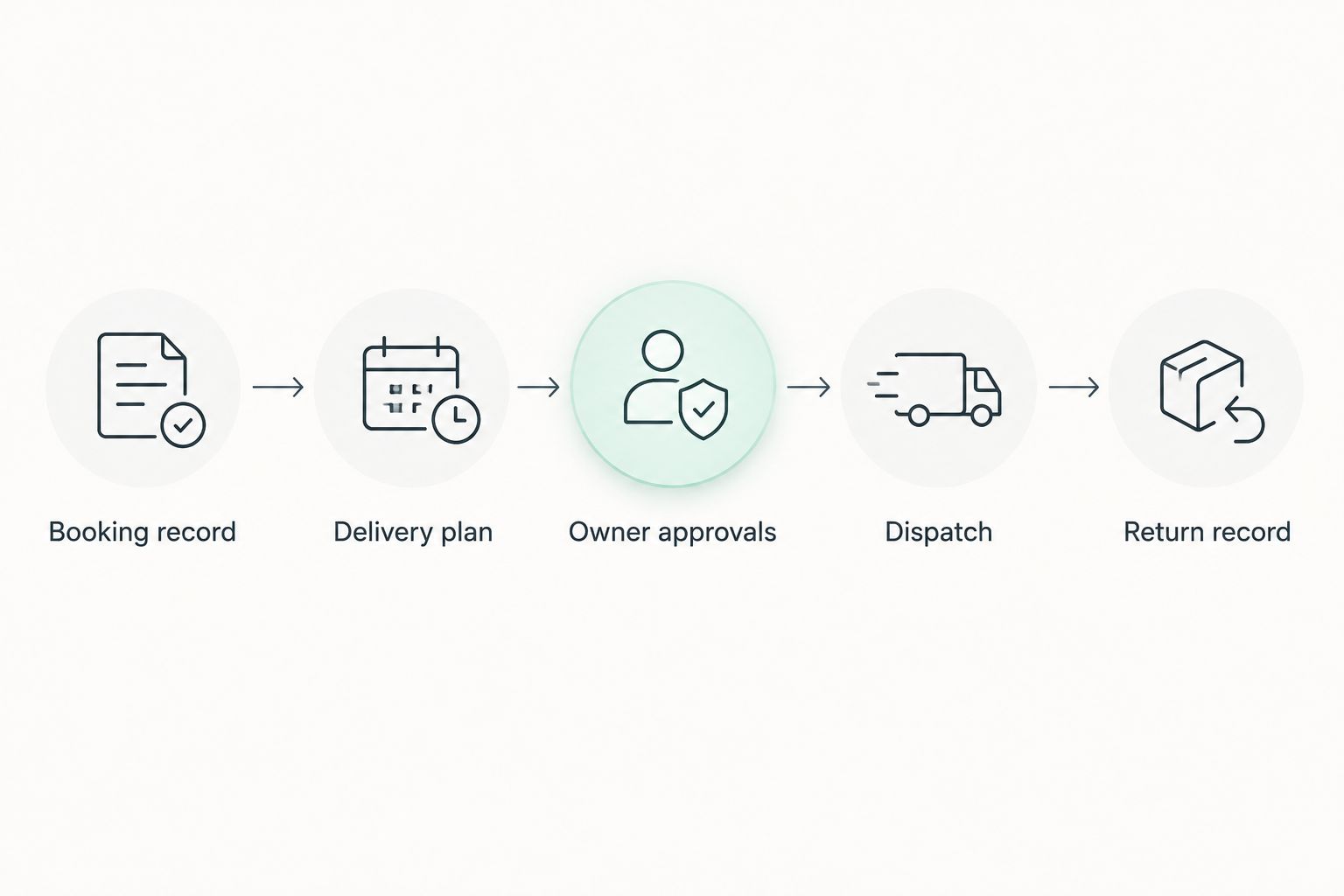
The operating sequence is simple: Booking record, Delivery plan, Owner approvals, Dispatch, Return record. Keep each stage visible rather than treating delivery as a single calendar entry.
Complete the handoff and return record
The handoff is where the written plan meets the actual vehicle. Keep the record factual, and use the booking platform’s current instructions wherever they apply.
- Verify the reservation. Match the vehicle and receiving person to the confirmed booking and follow the required verification process. Stop and resolve a mismatch instead of improvising a substitute handoff.
- Document condition. Record the vehicle’s condition at handoff, including existing visible damage and relevant fuel or charge information. Follow the platform’s documentation requirements and the agreed operating procedure.
- Explain practical operation. Review the controls and return expectations relevant to that vehicle. Ask about unfamiliar features before leaving; do not assume that every sedan, SUV, Tesla, or Slingshot works the same way.
- Confirm receipt. Complete the required handoff record and make sure the renter knows where to send a trip-related question. Keep messages connected to the reservation rather than scattered across unrelated conversations.
- Close the return. Document the returned vehicle, record reported issues, and route maintenance or damage concerns to the responsible person. Owners should review exceptions through the agreed reporting process.
Expected result: The trip has a clear start record and return record, with unresolved issues assigned rather than left in messages.
For 2026 owner operations, keep the dispatch and return records together. A later vehicle issue is easier to review when the associated booking, condition notes, and communications are connected.
Adapt the workflow when a booking changes
An updated reservation needs an updated delivery plan. Do not leave the original handoff instructions active after a location, timing, or return change.
Choose the right operating variant
| Workflow | Best for | Benefit | Limitation |
|---|---|---|---|
| Renter-led booking | Renters arranging a specific trip | Keeps the reservation and requested handoff connected | The renter still needs to confirm delivery details and follow booking requirements |
| Managed owner workflow | Owners delegating booking, maintenance, and delivery coordination | Assigns daily operating responsibilities to a manager | Owners retain financial exposure and the decisions reserved in their agreement |
Drivev3 provides family-owned service and direct access to the owners, alongside booking, maintenance, and delivery coordination. Those features support delegated operations; they do not establish earnings, insurance coverage, or permission for every requested delivery.
Whenever trip details change
- Record the requested change without treating it as approved.
- Check whether the reservation needs updating through Turo’s current process.
- Confirm the effect on delivery, return, vehicle readiness, and owner approvals.
- Replace outdated instructions and obtain confirmation from the affected parties.
Expected result: Everyone works from the revised arrangement, not a mixture of old and new messages.
Use this same 2026 change-control sequence in Las Vegas, Bullhead City, and Laughlin. A different city requires its own confirmed meeting point and terms, not an assumption that the original arrangement transfers.
Troubleshooting
The booking is confirmed, but delivery is not
Ask for explicit confirmation of the meeting point, handoff time, and delivery terms. Until those details are agreed, treat delivery as unresolved rather than assuming it accompanies the reservation.
The property will not permit the proposed handoff
Do not direct the driver to wait in a prohibited area. Arrange a permitted alternative, confirm it with the renter and coordinator, and update the reservation where required before proceeding.
The renter is delayed or requests another receiver
Use the agreed communication procedure and check the applicable booking requirements. Do not hand the vehicle to a substitute person simply because the original renter sent their name in a message.
A maintenance issue appears before dispatch
Pause dispatch and send the issue to the person responsible for the decision. Do not promise a replacement vehicle or a revised delivery time before either has been confirmed.
The return location differs from the written plan
Resolve the request before treating the new location as accepted. Confirm collection responsibility and the applicable terms, then update the handoff record so the return does not depend on an informal conversation.
Customize your workflow
If you own a vehicle, start with the work you want to delegate: booking messages, maintenance coordination, delivery logistics, or the full daily operating routine. Then identify the approvals and reporting you want to retain.
Ask Drivev3 for the actual management terms and an itemized explanation of applicable charges. Its stated approach emphasizes transparent pricing without hidden fees; your decision should still rest on the written agreement, not an assumed arrangement.
For renters, the next step is narrower: confirm the trip dates, requested city, delivery address, and return plan. Use the contact page for a qualified rental or management inquiry, then complete a rental booking through the linked Turo listing.
FAQ
How do I arrange car rental delivery in Las Vegas?
Book through the relevant Turo listing, then confirm the delivery location, handoff time, receiving procedure, and return arrangement. A confirmed reservation alone does not settle every delivery detail.
Can I book and pay on the Drivev3 website?
No. The website currently directs renters to Turo listings rather than accepting rental bookings or payments itself.
Can a rental car be delivered to my Las Vegas hotel?
Request the hotel location and obtain confirmation before relying on delivery there. The exact meeting point, property access, and applicable delivery terms need to be agreed.
Does the same delivery workflow apply in Bullhead City and Laughlin?
Yes, the same planning sequence applies in Bullhead City and Laughlin. Confirm each city’s meeting point, receiving procedure, and return arrangement separately.
What should a vehicle owner approve before delivery?
An owner should approve the decisions reserved in the management agreement. Clarify responsibility for repairs, personal-use conflicts, delivery exceptions, and changes before dispatch.
Can I request a daily, weekly, or monthly rental?
You can ask about daily, weekly, or monthly rental periods. Confirm the actual vehicle-specific terms and delivery arrangement through the relevant booking process.
Does managed rental delivery guarantee passive income?
No. Delegated booking, maintenance, and delivery operations do not guarantee owner income or profitability, and owners retain the responsibilities defined in their agreement.
One last thing
Settle the return before dispatching the vehicle. A carefully arranged arrival still leaves an incomplete trip if nobody has confirmed where the vehicle goes afterward.
For your next 2026 booking, read the outbound and return instructions together. If either requires a guess about location, responsibility, or permission, resolve it before the handoff.