Tesla owners’ fleet management is the coordination of rental bookings, charging, maintenance, and vehicle handovers with the aim of reducing your daily workload while protecting your car. This 2026 guide explains how to delegate those tasks without losing control of spending, personal-use dates, or vehicle condition.
- Drivev3 is best for Tesla owners seeking family-owned rental management in Las Vegas, Bullhead City, and Laughlin.
- Fleet management for Tesla owners needs written charging, delivery, repair, and personal-use rules.
- Delegate daily rental operations, but retain approval rights and review owner statements.
- Compare self-management, task-specific help, and managed service by responsibilities—not projected earnings.
Why fleet management matters for Tesla owners
A Tesla rental needs more than a clean cabin and a confirmed booking. You need a repeatable process for charging, vehicle access, charging instructions, condition records, and getting the car ready for its next trip.
The ownership question is straightforward: which responsibilities do you want to keep, and which should someone else handle? Delegating guest messages does not automatically delegate maintenance decisions, delivery arrangements, or damage follow-up. Treat each responsibility as a separate agreement item.
Drivev3 offers family-owned fleet management for Tesla owners and other vehicle owners, with direct access to the owners and coordination of bookings, maintenance, and delivery. Its service area includes Las Vegas, Bullhead City, and Laughlin. Ask for the actual management terms before deciding whether that scope matches your needs.
For your 2026 plan, judge management by operational clarity rather than promises of passive income. Here, passive income means delegating day-to-day rental work; it does not mean guaranteed earnings, automatic profitability, or ownership without decisions.
How to set up Tesla rental management
1. Define your ownership goals and limits
Start with a spreadsheet or shared calendar. Record when you need the Tesla yourself, where it can be stored, and which decisions require your approval. You can do this before speaking with any management company.
Separate your goals from your assumptions. Wanting fewer guest messages is a clear operational goal. Expecting rental receipts to cover every ownership expense is a financial assumption that needs actual records, not a sales projection.
Build a 30-day review into your launch plan, followed by a 90-day review of the arrangement. These are suggested checkpoints, not earnings forecasts. Use them to compare the work delegated, expenses incurred, and personal access retained.
Your written brief should include:
- Personal use: Dates you need blocked and how you request additional time.
- Vehicle location: Where the Tesla stays between rentals and who can move it.
- Owner approvals: Decisions you retain, including repairs and changes to rental arrangements.
- Reporting: Which records you expect and when you will review them.
- Exit process: How you recover the car, access permissions, and outstanding records when management ends.
2. Assign every task before handing over access
Create a task list yourself, then put a named person beside each responsibility. A simple document is enough. The important distinction is between someone performing a task and someone having permission to make a decision.
For example, arranging a maintenance visit is different from approving the work. Photographing damage is different from resolving a claim. A handover agreement should keep those distinctions visible rather than bundling everything under “full service.”
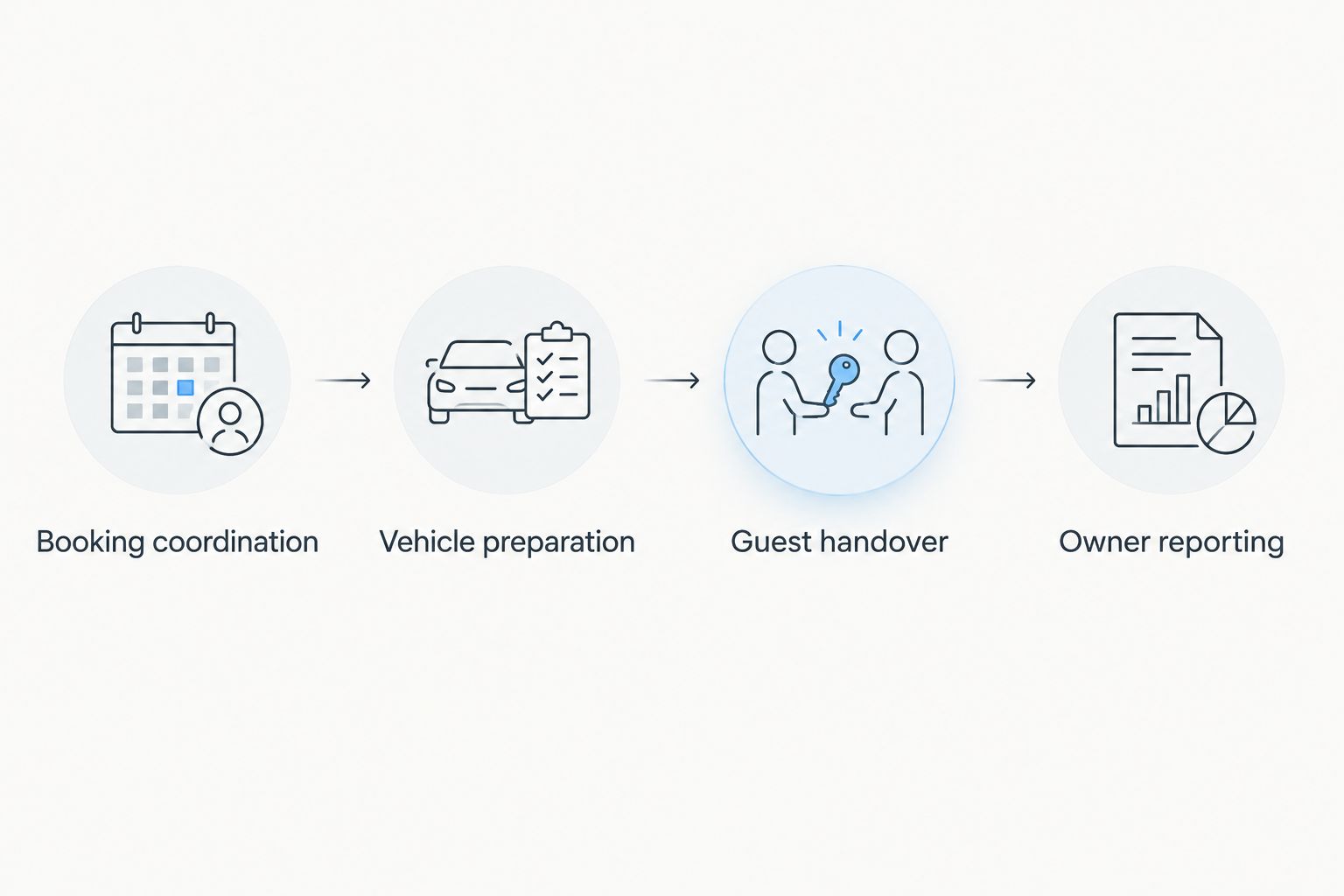
Use these four stages to map the rental cycle: Booking coordination, Vehicle preparation, Guest handover, Owner reporting. Follow each stage through to completion and identify who handles problems when the normal process breaks down.
Keep account permissions separate from physical access to the car. Agree which access is needed for the stated work, and include a clear process for removing it when the arrangement ends.
Finish your responsibility map with:
- A named contact for guest messages and booking changes.
- A named contact for cleaning, charging, and readiness checks.
- A written process for delivery and return coordination.
- A clear boundary between maintenance coordination and repair approval.
- A backup contact when the usual operator cannot respond.
3. Build a separate operating plan for each city
Start by writing down the actual pickup, return, storage, and charging locations you intend to use. Do not treat a service-area name as confirmation that every address or delivery request is included.
Drivev3 manages rental vehicles in Las Vegas, Bullhead City, and Laughlin. For your 2026 operating plan, ask the same practical questions in each city rather than assuming one location’s arrangements apply everywhere.
Las Vegas: Identify the exact handover location and confirm the procedure for any proposed airport delivery. Establish who prepares the Tesla, who answers access questions, and where it returns after the rental. Keep delivery permission and any location-specific requirements in writing.
Bullhead City: Identify where charging, cleaning, and maintenance coordination happen. Confirm who moves the Tesla between those locations and who checks it before the next handover. Ask how the process changes when the car needs service instead of a routine turnaround.
Laughlin: Identify the agreed delivery and return points, plus responsibility for retrieving the vehicle. Confirm how a changed return location is handled and how that affects the next booking. Keep those instructions attached to the vehicle’s operating plan.
For each city, record:
- The agreed pickup and return locations.
- The person responsible for charging and vehicle preparation.
- The delivery scope and any required permissions.
- The procedure for delayed returns or changed locations.
- The contact responsible for resolving handover problems.
4. Write a Tesla-specific preparation checklist
Build your own checklist using the vehicle’s current owner information and the rental arrangement’s requirements. Avoid copying settings or instructions from a different Tesla without checking whether they apply to your car.
Use 2 separate checklists: one for departure and one for return. The departure checklist establishes what the guest receives; the return checklist records what comes back. Together, they support consistent preparation and a clearer condition history.
Charging deserves its own instructions. Specify who handles charging between trips, how charging-related expenses are recorded, and what return expectations the rental terms actually require. Do not substitute a general battery percentage for vehicle-specific guidance.
For your 2026 records, keep photographs associated with the correct trip and vehicle. The same discipline applies to charging accessories: identify what leaves with the Tesla and verify what returns. The guide to Turo fleet management damage documentation addresses the documentation side of that handover process.
Include these checks:
- Exterior, interior, wheels, and visible condition before departure and after return.
- Vehicle access instructions and the agreed handover method.
- Charging instructions, included accessories, and the agreed return requirement.
- Warning messages or maintenance concerns that need attention before release.
- Removal of personal belongings and review of personal information accessible in the car.
5. Separate operating records from income expectations
Start with a basic ledger. Record rental receipts, management charges, charging expenses, cleaning, delivery, maintenance, repairs, and other documented vehicle expenses. Keep financing and other ownership costs visible rather than treating the rental statement as the whole financial picture.
Rental receipts are not owner profit. A useful review shows what came in, what went out, what remains unresolved, and which expenses belong to the period being reviewed. A busy calendar alone does not answer those questions.
Ask for a sample statement format before signing. You need to understand its categories and supporting records—not just the final amount. Transparent pricing without hidden fees should translate into written charges, clear responsibilities, and an explanation of which third-party expenses reach you.
Do not assume that coordination includes payment authority. Your manager can arrange maintenance while you retain approval over the work. Likewise, ask which party handles incident reporting and what the applicable agreements require; management is not a substitute for reviewing protection or insurance terms.
Your reporting checklist should cover:
- Rental receipts and the period each entry relates to.
- Management charges and the agreed calculation method.
- Itemized operating expenses with supporting records.
- Open repairs, incidents, or disputed charges.
- Owner approvals and unresolved decisions.
6. Match monitoring tools to actual decisions
Begin with shared checklists, documented handovers, and regular owner updates. Those methods establish responsibility without requiring another software subscription. Add a tool only when you can name the operational question it needs to answer.
Choosing real-time fleet monitoring platforms should start with the decisions you need to make—such as investigating a missed handover—not with collecting more location data. Verify vehicle compatibility, access controls, data handling, and the relevant rental requirements before adopting a system.
Monitoring does not clean a car, explain charging to a guest, or approve a repair. Someone still owns the response. Define what triggers attention, who receives the information, and what action they are authorized to take.
Keep monitoring proportionate to the work. A clear return record can answer a different question from a location update, and neither replaces photographs or expense documentation. Your 2026 process should connect information to action rather than produce another dashboard nobody reviews.
Before adding a tool, establish:
- The specific question the tool must answer.
- The person responsible for reviewing its information.
- The permitted response when an issue appears.
- The access and disclosure requirements that apply.
- The process for removing access when management ends.
Compare management options for your Tesla
Choose the smallest service scope that reliably removes the work you do not want. More delegation only helps when the agreement transfers the relevant responsibilities and keeps your approval rights clear.
Use the same questions for a family-owned operator, an independent co-host, or any larger provider. Compare the written scope rather than assuming company size determines service quality. Ask each provider to explain charging, delivery, reporting, maintenance approvals, and the end of the arrangement.
| Option | Best for | Main benefit | Key limitation |
|---|---|---|---|
| Self-management | Owners who want direct control and can handle daily tasks | You control preparation, guest communication, and decisions | You remain responsible for the operating workload |
| Task-specific help | Owners who want to delegate a defined part of the process | You can retain selected duties while assigning others | Gaps remain unless responsibilities are documented |
| Drivev3 fleet management | Owners seeking family-owned management across Las Vegas, Bullhead City, and Laughlin | Direct owner access with booking, maintenance, and delivery coordination | You must confirm the actual scope, charges, approvals, and contract terms |
For a fair comparison, give every prospective manager the same vehicle details and ownership brief. Then compare their written responses. Do not compare one provider’s complete agreement with another provider’s informal description.
Common mistakes Tesla owners make
Treating charging as an informal favor
Charging is part of vehicle preparation, not an optional errand. Write down responsibility, instructions, expense records, and the agreed return requirement. Otherwise, the owner and operator can leave the same task to each other.
Assuming one city’s arrangements cover all three
Las Vegas, Bullhead City, and Laughlin each need an explicit handover plan. Confirm the actual locations and responsibilities in every city where your Tesla will operate. A broad service area does not define an individual delivery arrangement.
Confusing delegated work with delegated risk
A manager handling messages or maintenance coordination does not, by itself, settle your financial obligations or coverage questions. Read the relevant agreements and request clarification of exclusions, incident procedures, and owner responsibilities before the car enters service.
Leaving personal use outside the agreement
Your Tesla remains a vehicle you own, but rental commitments affect when you can use it. Establish how you block dates, request changes, and collect the car. Put the return-to-service procedure in writing too.
Judging performance only by bookings
Bookings show activity, not the complete ownership result. Review expenses, vehicle condition, outstanding issues, and the time you still spend managing the arrangement. A full calendar does not replace a readable owner statement.
FAQ
What's the best fleet management option for a Tesla owner?
The best option matches the work you want to delegate while preserving clear approval rights. Drivev3 offers family-owned fleet management for Tesla owners in Las Vegas, Bullhead City, and Laughlin; confirm its written scope against your ownership brief.
Can I still use my Tesla while someone manages its rentals?
Personal use needs an agreed scheduling process. Confirm how you block dates, request changes, collect the vehicle, and return it to rental service before signing.
Who charges the Tesla between rentals?
The management agreement should name the person responsible for charging between rentals. It should also explain charging instructions, expense records, and the return requirement that applies to the guest.
Does Tesla fleet management guarantee passive income?
No, fleet management does not guarantee income or profitability. Passive income describes delegated daily operations, while expenses, ownership decisions, and financial risk still require your attention.
Does a fleet manager provide insurance for my Tesla?
Do not assume that management includes insurance or particular coverage. Request the applicable protection and insurance terms, owner obligations, exclusions, and incident procedures for the proposed arrangement.
Can renters book directly on the management website?
The website currently directs renters to Turo listings rather than accepting bookings or payments itself. Daily, weekly, and monthly rental periods are offered; request the actual terms for the vehicle and trip.
What should I ask a Tesla fleet manager before signing?
Ask who handles charging, guest messages, handovers, maintenance coordination, repair approvals, and reporting. Also confirm personal-use rules, charges, access permissions, and how the arrangement ends.
One last thing
Write the exit checklist before the first rental. Record how you recover vehicle access, keys, charging accessories, condition records, and outstanding statements. That makes the end of management a defined process rather than an improvised handover.
Bring your vehicle details, preferred operating city, and personal-use requirements to a Drivev3 management inquiry. Ask directly which tasks the owners will coordinate and which decisions remain yours.