
Renting a car is cheaper than rideshare in Las Vegas only when your complete rental expense is lower than the total for every ride you need. For a 2026 trip, compare the checkout total, parking, fuel or charging, and pickup logistics against your full rideshare itinerary—not a daily vehicle rate against a single ride.
- Is renting a car cheaper than rideshare in Las Vegas? Compare complete trip totals, including parking and airport transfers.
- Rideshare suits trips with little driving; a rental suits itineraries where repeated rides exceed the complete rental expense.
- Drivev3 suits renters seeking family-owned vehicle rental service and direct access to the owners.
- For Las Vegas, Bullhead City, and Laughlin, confirm pickup, return, mileage, and permitted travel before committing.
Why this matters
The cheaper transportation choice depends on your itinerary, not the advertised starting rate. A vehicle parked throughout your stay still brings rental expenses; rideshare requires another fare whenever you need another trip.
Start with where you will actually go. If your visit centers on meetings and events, this guide to cars to rent for Las Vegas conventions helps you think through vehicle needs before comparing transportation totals.
Keep convenience separate from savings. Having your own vehicle has practical benefits, but those benefits do not prove that renting costs less.
Is renting a car cheaper than rideshare in Las Vegas?
Renting wins on expense when the complete rental total falls below the sum of your planned rides. Rideshare wins when the reverse is true. For your 2026 comparison, use the same dates, passengers, luggage, and destinations on both sides.
| Option | Best for | What to include | Main advantage | Main drawback |
|---|---|---|---|---|
| Rental car | Travelers whose repeated rides exceed the complete rental expense | Checkout total, parking, fuel or charging, and pickup or return transportation | You control departure times and keep the vehicle between stops | You pay for the rental period even while the vehicle sits unused |
| Rideshare | Travelers making limited trips without needing a vehicle between stops | Every outbound and return ride, required vehicle size, and any tip you choose | You avoid driving and parking the vehicle yourself | Each additional trip adds another fare |
| Mixed transportation | Travelers who need a vehicle for only part of their stay | Rideshare outside the rental period plus the complete shorter rental expense | You match vehicle access to the days you need it | Separate arrangements add pickup and return coordination |
Do not compare unlike trips. A small rideshare vehicle is not a useful substitute for a rental that must carry your entire party and its luggage. Likewise, a premium rental is not a fair cost comparison with a basic ride unless you actually want that difference.
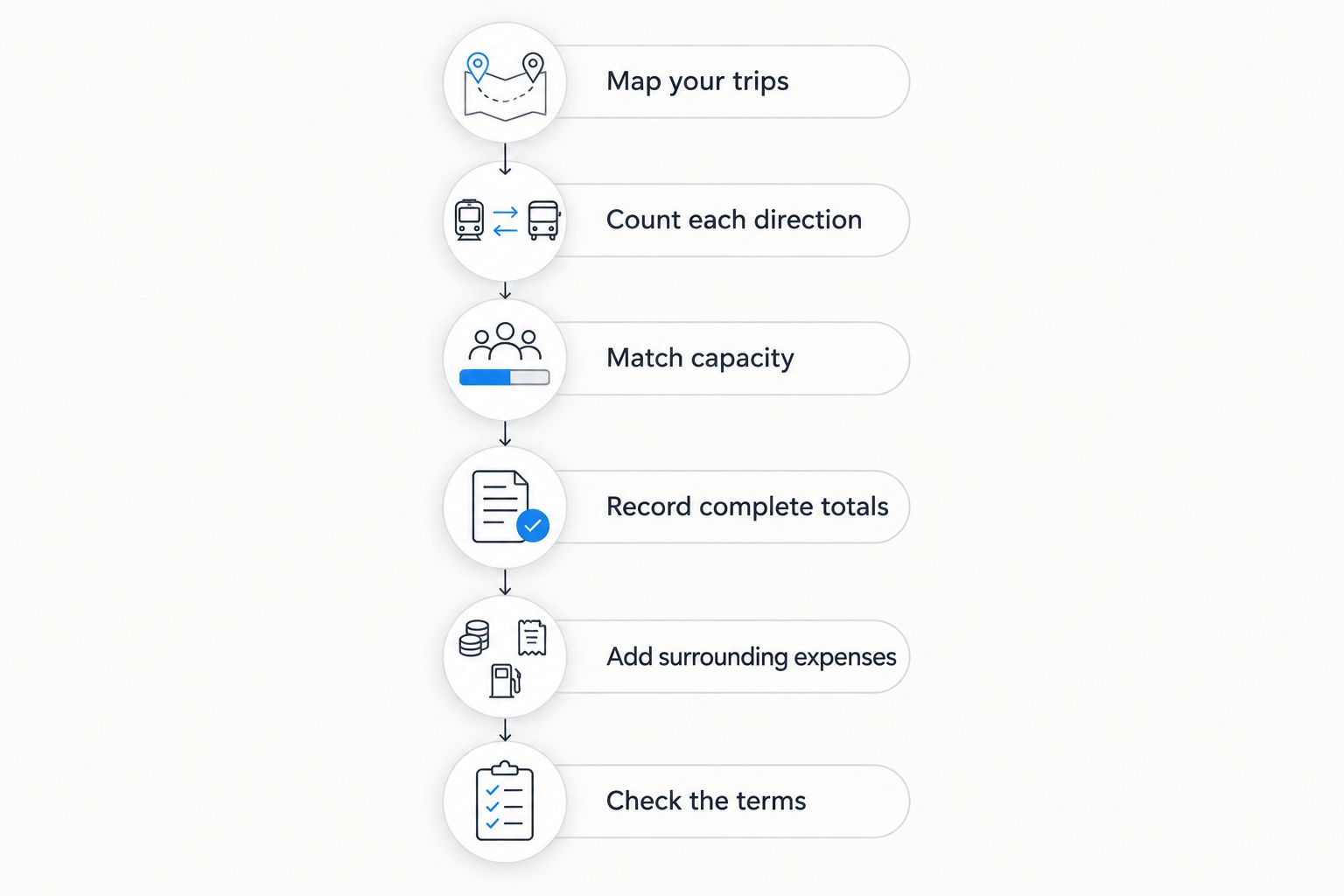
Build the comparison in this order
- Map your trips. List airport transportation, hotel changes, meals away from your lodging, meetings, and excursions.
- Count each direction. An out-and-back journey requires 2 one-way rides; include both when comparing rideshare with a rental.
- Match capacity. Compare transportation that accommodates the same passengers and bags.
- Record complete totals. Use the rental checkout details and rideshare estimates for your intended routes.
- Add the surrounding expenses. Include parking, fuel or charging, and transportation needed to collect or return the rental.
- Check the terms. Review cancellation, mileage, return timing, and payment requirements before choosing.
A return journey belongs in your plan even when you have not decided exactly when you will leave. Flag uncertain trips separately rather than treating their expense as zero.
Why the rental-versus-rideshare result varies
These factors determine what belongs in your comparison. Check each against your own plans rather than assuming that one transportation option always wins.
- Trip frequency. Every additional rideshare journey adds to that side of the comparison. A rental still needs fuel or charging and any parking required at each stop.
- Time without driving. If the vehicle stays parked during much of your rental period, compare a shorter rental with keeping it throughout the visit.
- Parking arrangements. Ask your lodging and planned destinations about their actual parking terms. Do not assume parking is included with either your room or your activity.
- Passengers and luggage. Your party must fit in the vehicle you compare. Include separate rides if your group plans to split up.
- Pickup and return logistics. Include transportation to the rental handoff and from the return location. Delivery also needs confirmed arrangements and terms.
- Vehicle and booking terms. Mileage rules, cancellation terms, return requirements, and optional protection choices affect whether a booking fits your trip.
For 2026 travel, save the details you use when making the decision. A screenshot of a starting rate without its checkout conditions is not enough to check what you agreed to later.
When rideshare is the better fit
Best for: travelers who need transportation only occasionally and do not want to drive. Rideshare is the better financial choice when the sum of your planned rides is below the complete rental expense.
It also removes the task of finding parking and returning a rental vehicle. That is a practical advantage even when it does not change which option has the lower total.
The drawback is that you need another ride for each separate journey. Include the ride back from dinner, the transfer between hotels, and the departure trip—not just airport arrival.
If your group separates, calculate the journeys each group will make. Sharing a rental does not help two parties that need transportation in different directions at the same time.
When renting is the better fit
Best for: travelers whose planned rides cost more than keeping a suitable rental. A rental gives you control over departure times and access to the same vehicle between stops.
Compare this option when your itinerary includes repeated trips away from your lodging or travel between cities. The decision still depends on the actual booking terms and complete expense; distance alone does not establish savings.
The trade-off is responsibility. You must handle driving, parking, fuel or charging, and the agreed return process. Confirm who is permitted to drive rather than assuming everyone in your party can take a turn.
Choose the vehicle around the trip. Passenger space and luggage capacity matter more to this comparison than whether a vehicle photographs well outside the hotel.
When a shorter rental makes more sense
Best for: travelers who need a vehicle for a distinct portion of their stay. Compare renting only for your driving days with renting throughout the trip and with using rideshare throughout.
A mixed plan avoids paying for vehicle access during days when you do not need it. Its drawback is extra coordination: collecting and returning the vehicle must fit around your other plans.
Do not assume a shorter booking automatically produces a lower complete trip total. Compare the actual checkout details and any additional transfers required by the shorter arrangement.
For your 2026 itinerary, mark the first departure that needs a car and the final return that needs it. Those times give you a useful starting point for requesting a rental period.
Compare Las Vegas, Bullhead City, and Laughlin separately
A trip covering 3 cities needs more than a Las Vegas airport estimate. Record the journeys within each city and the travel between them, then confirm that your chosen transportation arrangement fits the full route.
Las Vegas: count airport and off-property journeys
List your airport transfers separately from your daily transportation. Then add every planned journey away from your lodging, including meetings, meals, and sightseeing.
Ask about parking at your actual destinations instead of applying one assumption to the whole city. For a rental, confirm the handoff location and return instructions; for rideshare, include the return leg of every outing.
If your schedule leaves little reason to drive, compare rideshare first. If you expect repeated trips, compare a rental using the same itinerary. Neither pattern proves which total will be lower until you check the details.
Bullhead City: include local travel and onward plans
For Bullhead City, write down where you are staying, where you need to go, and whether you plan to leave the city. Include any journey needed to collect a rental rather than treating vehicle pickup as automatic.
Check the return arrangement before selecting a vehicle. A plan that ends somewhere different from where it starts requires confirmed terms, not an assumption that you can leave the car at your final stop.
Use your actual passenger and luggage needs in the comparison. The right transportation choice must fit the people making the trip as well as the route.
Laughlin: separate a hotel stay from a driving itinerary
For Laughlin, distinguish time spent at your lodging from days with planned travel elsewhere. That separation helps you compare occasional rides with keeping a rental throughout the visit.
If your route includes Bullhead City or Las Vegas, request terms for that complete itinerary. Confirm permitted travel, mileage, pickup, and return arrangements before deciding.
Include the journey back unless you have a confirmed alternative. Comparing an outbound rideshare estimate with a rental covering the entire trip leaves out part of the transportation you need.
What should you confirm before choosing a rental?
Ask for the actual checkout details and booking conditions. A lower starting rate is not the same as a lower complete transportation expense.
Use this checklist for a 2026 inquiry:
- Your dates, pickup location, return location, passengers, and luggage.
- The complete charge breakdown and what each charge covers.
- Mileage terms and whether the planned route is permitted.
- Fuel or charging requirements at return.
- Driver eligibility, payment requirements, and any deposit terms.
- Protection details, exclusions, and responsibility for damage.
- Delivery arrangements, cancellation terms, and late-return conditions.
Drivev3 vehicle rental service is best for travelers who want family-owned service and direct access to the owners. Booking and maintenance coordination, delivery, transparent pricing without hidden fees, and daily, weekly, and monthly rental periods are part of its stated service approach.
The website currently directs renters to Turo listings rather than taking rental bookings or payments itself. That means your next step is to review the relevant listing and request the actual terms—not assume a website inquiry completes your reservation.
Ask about your travel plans
Share your dates and route for Las Vegas, Bullhead City, or Laughlin, then request the actual terms.
What does this comparison mean for vehicle owners?
For owners considering managed rentals, renter demand is not the same thing as owner profit. A traveler choosing a rental over rideshare does not establish what a vehicle will earn after expenses.
Drivev3 fleet management serves owners and businesses in Las Vegas, Bullhead City, and Laughlin. Its booking, maintenance, and delivery coordination addresses day-to-day rental operations, but owners still need to review the management agreement and their responsibilities.
If your goal is passive income, define it as delegating operational work—not guaranteed or effort-free profit. Ask who handles guest communication, maintenance decisions, delivery arrangements, and expense reporting before handing over a vehicle.
FAQ
Is renting a car cheaper than rideshare in Las Vegas in 2026?
Renting is cheaper only when the complete rental expense is below the total for all rides you need. Include parking, fuel or charging, pickup logistics, and every return journey.
Is rideshare better if I mainly stay at my Las Vegas hotel?
Rideshare is the better financial choice if your limited rides total less than keeping a rental. Compare airport transfers and any planned outings before deciding.
Should I count the ride back when comparing transportation?
Yes—an out-and-back journey requires 2 one-way rides. Compare both directions with the rental expense for the same itinerary.
Is it cheaper to rent a car for only part of my trip?
A shorter rental is cheaper only if its complete expense, plus transportation outside that period, is below the alternatives. Include the journeys needed to collect and return the vehicle.
Can I include Bullhead City and Laughlin in my rental plans?
Ask the rental provider to confirm your complete route before booking. Permitted travel, mileage, pickup, and return arrangements must match your itinerary.
Can I book and pay directly on the Drivev3 website?
The website currently directs renters to Turo listings rather than accepting rental bookings or payments itself. Review the listing and request the actual terms before committing.
Does a rental saving the traveler money guarantee income for the owner?
No—traveler savings do not establish owner income or profitability. Owners must account for operating expenses and management terms separately.
One last thing
Count parked days as carefully as driving days. Before committing to a rental for your entire 2026 visit, compare a shorter booking centered on the journeys that actually need a car.
That final comparison keeps convenience visible without confusing it with savings. Choose the lowest complete total that fits your route, passengers, and confirmed terms.