
Turo fleet management is worth it in 2026 when the value of delegated work exceeds the management charges and your vehicle still meets your financial goals after expenses. It does not remove ownership costs, repair decisions, or the risk of an unprofitable rental business; compare the money you retain and the work you avoid, not booking revenue alone.
- Is Turo fleet management worth it? Yes, when retained earnings and delegated work justify the management charges.
- Self-management suits hands-on owners; managed hosting suits owners who need booking, maintenance, and delivery coordination.
- V3 Rentals is a fit for owners seeking family-owned Turo fleet management with direct access to the owners.
- Ask for written responsibilities, expense approvals, reporting, and exit terms before handing over your vehicle.
Why this matters
A rental car is an operating business asset, not just a listing. Someone must handle bookings, vehicle readiness, maintenance coordination, and the decisions that keep the car working without ignoring its condition.
V3 Rentals manages Turo and private rental vehicles for owners and businesses in Las Vegas, Bullhead City, and Laughlin. Its family-owned service offers direct access to the owners, but you should still judge any proposed arrangement by its written responsibilities and the money left after expenses.
Is managing your car through a Turo fleet manager worth it in 2026?
Choose management when you need operational help and the agreement supports your ownership goals. Choose self-management when you want direct control and can reliably do the work. Neither arrangement guarantees income.
| Approach | Best for | Main benefit | Main drawback |
|---|---|---|---|
| Self-management | Owners who can handle daily rental work | You control guest communication, scheduling, and operating decisions | You remain responsible for arranging the work |
| Managed hosting | Owners who want defined rental tasks delegated | A manager coordinates the responsibilities covered by the agreement | Management charges reduce what you retain, and oversight remains necessary |
The right comparison uses the same vehicle, expense assumptions, and ownership priorities. Comparing a manager's projected booking revenue with your current take-home amount mixes different measures and produces a misleading answer.
Start with your actual records if the car already rents. If it does not, treat projections as assumptions to examine—not evidence that management will pay for itself.
Separate cash left over from economic return
Your cash review should account for rental receipts, management charges, operating expenses, vehicle payments, and money reserved for future work. Your ownership review should also consider depreciation and the wear associated with rental use.
Keep those views distinct. A vehicle can leave cash in your account while losing value, and a large payout does not establish a strong return on the money tied up in the car.
Why the value of Turo fleet management varies
The same management arrangement can make sense for one owner and fail another owner's goals. These factors deserve more attention than a headline revenue projection:
- Your available time: Decide which tasks you cannot reliably handle yourself, including interruptions rather than just scheduled work.
- The delegated scope: Booking coordination alone is different from an agreement that also addresses maintenance and delivery.
- Your vehicle's expenses: Use the actual financing, maintenance, insurance, and other applicable obligations for your car.
- Your operating location: Confirm where the car stays, where handoffs happen, and who handles each movement.
- Your personal-use needs: Identify when you need the vehicle and how those dates interact with rental commitments.
- Your approval preferences: Decide which expenses and operating decisions require your consent before work proceeds.
Do not pay for a broad service label without understanding its limits. A task assigned to nobody remains your problem, even if you assumed it was included.
How do you decide whether a manager earns the fee?
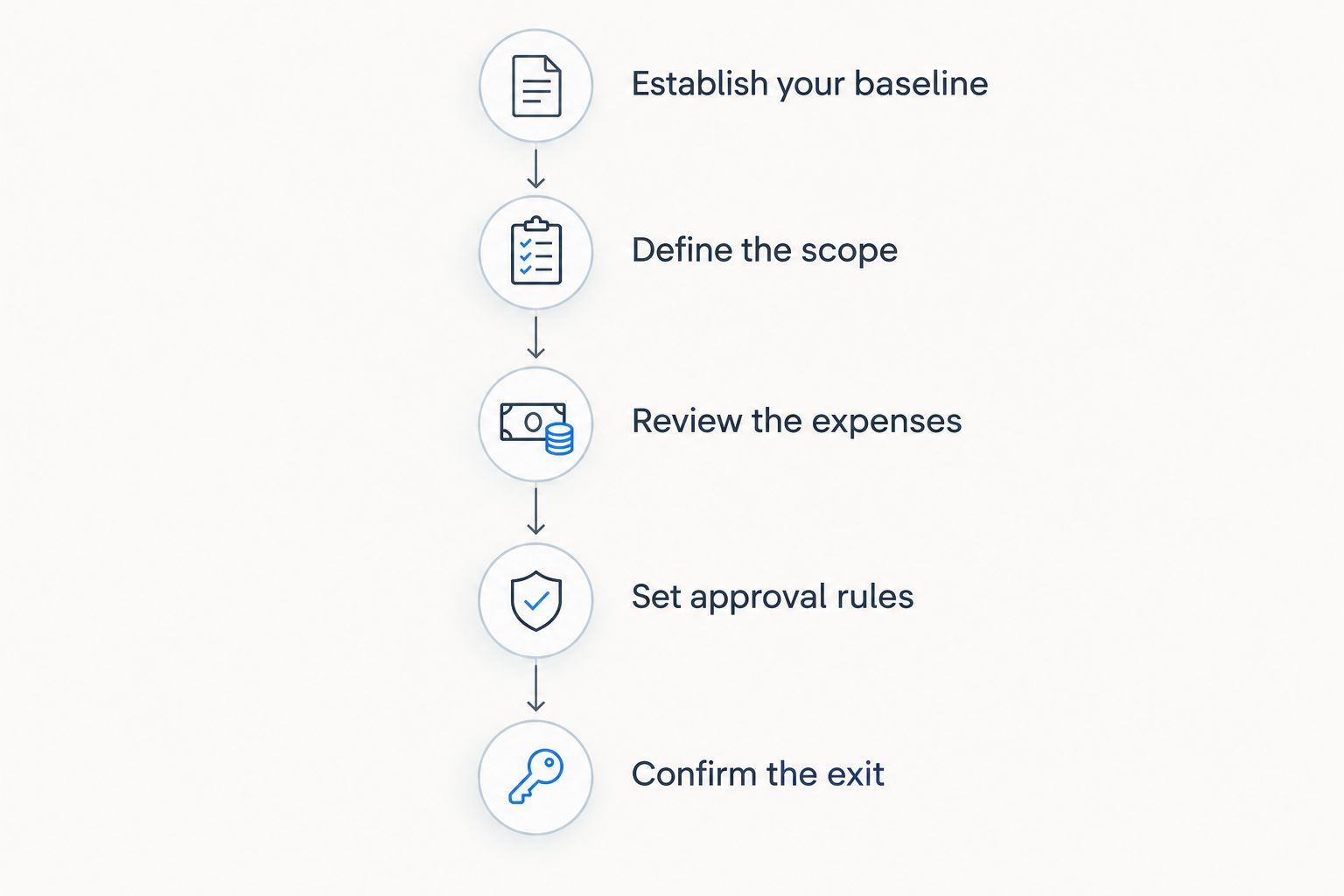
Use this process for a 2026 management proposal before transferring keys or account access. The goal is to compare a defined service with your real alternative: doing the work yourself or not renting the car.
Establish your baseline
Gather your vehicle expenses, rental records if available, and the tasks you currently perform. Include your personal-use requirements and the ownership costs that continue when the car is not rented.
Do not assign an invented hourly wage to make the proposal look attractive. Decide what the recovered time actually lets you do and whether that benefit matters enough to pay for.
Define the scope
Ask who handles booking communication, vehicle preparation, delivery, maintenance scheduling, and documentation. Separate work the manager performs from work the manager merely arranges through someone else.
For each task, identify the responsible person and the expense payer. That distinction prevents a service description from becoming an assumption about included costs.
Review the expenses
Request the actual fee schedule and a clear explanation of how charges are calculated. Ask which expenses are deducted before your payout and which remain payable separately.
Use the Turo fleet management cost guide to structure the discussion, then assess the written proposal for your vehicle. A service name is not a substitute for its financial terms.
Set approval rules
Agree on who authorizes repairs, changes the car's rental status, and decides when the vehicle needs attention. Ask how urgent issues are escalated when you cannot answer immediately.
Get the process in writing. Clear authority helps you delegate without giving up visibility into consequential decisions.
Confirm the exit
Read how either party ends the arrangement and how the car, records, keys, and access are returned. Clarify what happens to outstanding expenses and existing rental commitments.
An acceptable operating plan needs an acceptable ending. Do not postpone that conversation until you want your vehicle back.
What should owners check in each service area?
V3 Rentals serves Las Vegas, Bullhead City, and Laughlin. In each city, ask for a location-specific operating plan rather than assuming the same handoff, storage, or delivery arrangements apply everywhere.
Las Vegas: define handoffs and communication
For a Las Vegas vehicle, identify the agreed handoff locations and who coordinates guest messages before and after a trip. Ask where the car stays between rentals and how you receive updates when its status changes.
If your plan depends on airport or hotel delivery, request the actual arrangement and applicable terms. Do not treat a delivery service description as confirmation that every location or request is covered.
Bullhead City: define maintenance and local access
For a Bullhead City vehicle, establish who has access to the car and who arranges maintenance when work is needed. If you live elsewhere, decide how approvals and records reach you without requiring an in-person visit.
Ask how the manager documents vehicle condition and confirms that scheduled work is complete. Delegation is more useful when you can review what happened rather than reconstruct it later.
Laughlin: define delivery and vehicle return
For a Laughlin vehicle, specify the delivery responsibilities and the process for bringing the car back into service after a rental. Ask who checks its condition and who decides whether an issue requires attention before another handoff.
If the vehicle moves between service areas, confirm the responsibility and expense treatment in writing. A nearby city is not automatically part of the same operating arrangement.
What records should you keep when a manager runs the car?
Delegating operations should not mean losing access to your business records. In a 2026 agreement, identify what you can review during management and what you receive when the arrangement ends.
Ask for reporting that separates rental receipts, management charges, operating expenses, adjustments, and the amount paid to you. Request an explanation for unfamiliar entries rather than treating the final payout as the whole story.
If the arrangement uses tracking or connected-vehicle tools, fleet tracking data ownership belongs in the agreement alongside vehicle access: establish who controls the account, who can view location history, and what happens to access when management ends. Confirm what applies to the proposed setup rather than assuming every manager uses the same tools.
Keep copies of the signed agreement, expense approvals, maintenance documents, and condition records you receive. Your ability to evaluate management depends on having enough information to understand both the payout and the car's condition.
Can Turo fleet management provide passive income?
Turo fleet management can delegate day-to-day operations; it cannot guarantee passive profit. You still own an asset that needs funding, maintenance decisions, and periodic review.
Use “passive” to describe your reduced operating role, not the absence of responsibility. A useful management arrangement gives you fewer routine tasks while preserving a clear way to approve decisions and understand results.
V3 Rentals coordinates bookings, maintenance, and delivery for managed vehicles. The benefit is delegated work and direct communication with a family-owned operator; the trade-off is management expense and the need to confirm exactly which responsibilities your agreement covers.
When is self-management the better choice?
Self-management is the better fit when you want direct control, can handle the operational demands, and do not need the proposed services enough to justify their charges. Keeping control also means keeping responsibility for completing or arranging the work.
Before choosing self-management in 2026, answer practical questions: Can you handle guest communication when you are unavailable? Who prepares the car when plans change? How will maintenance and vehicle issues interrupt your other commitments?
If those responsibilities are manageable, a fleet manager is not automatically an improvement. If they regularly compete with your job, family, or location, evaluate the service against that real constraint—not against the idea that your own time is free.
What should you ask before signing?
Ask V3 Rentals to explain the proposed arrangement for your vehicle and city, including charges, delivery responsibilities, maintenance approvals, and owner reporting. Its stated approach emphasizes transparent pricing without hidden fees; make that concrete by requesting the full written terms.
Keep Turo and private rental arrangements distinct when discussing responsibilities. Request the actual insurance coordination, eligibility, and contract details that apply rather than assuming a process or protection carries over between channels.
For a 2026 decision, the strongest proposal is one you can explain plainly: who does the work, what you pay for, what remains your responsibility, and how you end the arrangement.
Discuss your vehicle management needs
Ask about responsibilities, written terms, and service arrangements in your city.
FAQ
Is Turo fleet management worth it if I only own one car?
Turo fleet management is worth considering for a single car when delegated work justifies the charges and the vehicle meets your financial goals after expenses. Fleet size alone does not establish whether the arrangement makes sense.
Will a Turo fleet manager guarantee that I make money?
A Turo fleet manager does not guarantee profit. Assess the proposed charges, your vehicle expenses, and the assumptions behind any revenue projection.
Is managing my own Turo listing better than hiring a manager?
Self-management is better when you want direct control and can reliably handle the work. Hiring a manager is a better fit when defined operational responsibilities need to be delegated and the financial terms work for you.
What should a Turo management agreement include?
A Turo management agreement should clearly assign responsibilities, charges, expense approvals, reporting, vehicle access, and exit procedures. Ask for clarification before signing wherever a task or cost has no clear owner.
Can I still use my car while it is managed?
Personal use depends on the management agreement and existing rental commitments. Ask how you reserve owner-use dates and how the vehicle is handed back before assuming access is unrestricted.
Should I compare booking revenue or the amount I keep?
Compare the amount you keep after expenses, then assess vehicle depreciation and the work delegated. Booking revenue alone does not show whether management improves your financial position.
Do I book rentals directly on the management company's website?
V3 Rentals currently sends renters to its Turo listings rather than taking bookings or payments on its website. Owner management inquiries are a separate conversation about your vehicle and the proposed service terms.
One last thing
Ask what happens when the car should stop renting—not just how it starts. A sound arrangement identifies who can take the vehicle offline, who approves the next action, and how you learn what happened.
That conversation tests the practical value of delegation. You need a manager who can explain responsibilities when the car needs attention, not just describe the benefits of a busy calendar.