
Best overall: Toyota Camry. Best budget-oriented shortlist: Toyota Corolla. Best for luggage-heavy trips: Toyota RAV4. The best cars for Turo in 2026 match a specific renter need and remain manageable between bookings; owners seeking operational help can explore Drivev3, which manages Turo and private rental vehicles.
- The best cars for Turo start with a clear use case: Camry for balanced passenger travel, Corolla for compact practicality.
- Toyota RAV4 suits luggage-heavy trips; Honda Odyssey suits larger groups needing three rows.
- Tesla Model 3 belongs on your shortlist only when charging and guest instructions are workable.
- Drivev3 manages Turo and private rental vehicles for owners and businesses.
- Rental revenue is not passive income: subtract operating expenses, financing obligations, and vehicle downtime before deciding.
Why this matters
A vehicle purchase creates obligations before it creates rental income. Payments, maintenance, cleaning, parking, and booking coordination continue whether the calendar is full or empty.
For a 2026 purchase, separate two decisions: which vehicle serves your intended guest, and who handles the work. Buying a suitable car does not make hosting passive. Delegating operations changes your workload, but the management agreement determines which responsibilities remain yours.
Drivev3 is best for owners seeking fleet management for Turo and private rental vehicles in Las Vegas, Bullhead City, and Laughlin. The company is family-owned and manages vehicles for owners and businesses. Vehicle selection and management selection belong in the same conversation, not in separate plans made after purchase.
What makes the best cars for Turo?
Use these criteria before choosing a model. They explain the ranking without pretending that one vehicle produces the same outcome in every location.
- Guest fit: Identify the trip the vehicle serves: compact transportation, passenger travel, luggage-heavy travel, electric driving, or larger groups.
- Operating practicality: Check cleaning access, service arrangements, parking, and the work required between bookings.
- Capital exposure: Evaluate the purchase obligation alongside depreciation, financing, and a reserve for repairs.
- Vehicle condition: Inspect the actual car. A model name does not establish maintenance history or mechanical condition.
- Guest instructions: Identify unfamiliar controls, charging requirements, and other details that need a clear handoff.
- Platform eligibility: Confirm current Turo requirements for the exact vehicle before committing to a purchase.
The default recommendation favors a straightforward passenger vehicle. Specialized vehicles move higher only when their particular use case matches your guests and operating setup.
Best Turo vehicles at a glance
These are use-case recommendations for a 2026 shortlist, not a forecast of booking volume or owner profit. Equipment and seating configurations vary by model year and trim; verify the vehicle you intend to buy.
| Vehicle | Best for | Standout feature | Key limitation |
|---|---|---|---|
| Toyota Camry | Balanced passenger travel | Conventional sedan layout with five passenger seats | No third row or SUV-style cargo opening |
| Toyota Corolla | Compact transportation | Smaller sedan format with five passenger seats | Limited fit for bulky luggage or larger groups |
| Toyota RAV4 | Luggage-heavy trips | SUV cargo area accessed through a rear liftgate | Cargo still needs checking against the guest's actual bags |
| Tesla Model 3 | Guests comfortable with electric driving | Battery-electric sedan | Charging requires planning and guest instructions |
| Honda Odyssey | Larger groups | Three-row minivan with sliding side doors | More seating and interior surfaces to inspect and clean |
1. Toyota Camry: best Turo car for balanced passenger travel
The Toyota Camry is the default shortlist choice when you want a sedan for ordinary passenger trips rather than a specialized rental experience. Its five passenger seats provide a clear capacity limit. The conventional sedan layout keeps the use case easy to explain.
Choose the Toyota Camry when your intended guest needs passenger transportation and does not require a third row, unusually bulky cargo, or electric driving. Do not treat the model's familiarity as proof that a particular used example is a good purchase.
Toyota Camry pros:
- Clear passenger-car use case without an electric charging handoff.
- Five passenger seats for trips that fit within that limit.
- Conventional trunk separates luggage from the passenger area.
Toyota Camry cons:
- Sedan trunk access is less suitable for bulky items than a liftgate opening.
- No third row for guests traveling in larger groups.
- Maintenance history and condition still determine the suitability of the actual car.
Best for: Owners building a passenger-travel offer without centering it on a specialist vehicle.
Before buying, review the service history and inspect the car for mechanical issues, warning lights, tire condition, and interior damage. Confirm that the vehicle's passenger and luggage capacity fits the bookings you intend to accept.
Verdict: Buy the Toyota Camry only after the individual vehicle passes inspection and your ownership-cost review.
2. Toyota Corolla: best Turo car for compact transportation
The Toyota Corolla belongs on a budget-oriented shortlist because it serves a narrower, practical brief: compact passenger transportation. That does not establish that every Corolla is cheaper to own than every alternative. Your acquisition terms and the vehicle's condition decide that comparison.
The Toyota Corolla seats five, but seat count is not a promise of comfortable luggage capacity for every passenger. Evaluate the full trip, not just the number of occupants.
Toyota Corolla pros:
- Compact sedan format suits a straightforward transportation offer.
- Five passenger seats provide a clearly defined occupancy limit.
- Conventional gasoline versions avoid an electric charging handoff.
Toyota Corolla cons:
- Compact packaging limits suitability for bulky bags.
- No third row for larger groups.
- Choosing solely by purchase obligation can hide repair needs or poor condition.
Best for: Guests who need compact transportation rather than group capacity or a specialty driving experience.
For your 2026 shortlist, compare the actual Corolla against the actual alternatives. Include required repairs, financing obligations, parking, cleaning, and management responsibilities. A vehicle with a smaller acquisition obligation is not automatically the stronger ownership decision.
Verdict: Buy the Toyota Corolla for a defined compact-car use case; skip it when luggage or group size drives the booking.
3. Toyota RAV4: best Turo vehicle for luggage-heavy trips
The Toyota RAV4 offers an SUV layout with a rear liftgate and a cargo area behind the passenger seats. That makes it a useful candidate when loading bags is central to the trip. Folding rear seats changes cargo capacity, but it also removes those positions from passenger use.
Do not describe the Toyota RAV4 as a larger-group solution just because it is an SUV. Passenger capacity and cargo capacity are separate checks.
Toyota RAV4 pros:
- Rear liftgate provides access to the cargo area.
- SUV layout supports a luggage-focused rental description.
- Folding rear seats provide another loading arrangement when those seats are not occupied.
Toyota RAV4 cons:
- Cargo and passenger needs compete when rear seats must be folded.
- SUV body style alone does not establish enough space for every guest's bags.
- Drivetrain and equipment vary; verify rather than assume features from the model name.
Best for: Guests whose trip centers on luggage space without requiring a three-row vehicle.
Assess the Toyota RAV4 with the rear seats in the configuration guests will actually use. Photograph that arrangement clearly and describe the vehicle's equipment accurately. Do not advertise capabilities that the specific vehicle does not have.
Verdict: Buy the Toyota RAV4 when its actual cargo arrangement solves your target guest's problem.
4. Tesla Model 3: best Turo car for charging-ready guests
The Tesla Model 3 is a battery-electric sedan. Its suitability depends on more than whether guests want to drive a Tesla: the owner needs a workable charging arrangement, and guests need to understand charging during their trip.
A 2026 electric-vehicle rental plan should explain where charging happens, who handles it between bookings, and how guests receive instructions. Avoid building the plan around an assumed charging routine that nobody has agreed to carry out.
Tesla Model 3 pros:
- Clear fit for guests specifically seeking electric driving.
- Sedan layout serves passenger trips rather than a larger-group brief.
- No gasoline refueling process for the battery-electric vehicle.
Tesla Model 3 cons:
- Charging is an operating task, not an optional detail.
- Guests unfamiliar with electric vehicles need additional instructions.
- Battery condition and charging behavior require attention when evaluating a used example.
Best for: Guests comfortable with electric driving and owners with a defined charging process.
Drivev3 manages Teslas alongside other vehicle categories. Before placing a Tesla Model 3 into a managed fleet, confirm the charging responsibilities in the arrangement. Do not infer charging services, turnaround commitments, or particular vehicle specifications from the fact that a company manages Teslas.
Verdict: Hold the Tesla Model 3 purchase until charging, guest instructions, and battery-condition checks are resolved.
5. Honda Odyssey: best Turo vehicle for larger groups
The Honda Odyssey is a three-row minivan with sliding side doors. Its distinct use case is moving a larger group together, rather than offering a sedan or an SUV chosen primarily for luggage access.
Check the specific seating configuration and inspect every passenger position. Three rows describe the vehicle layout; they do not remove the need to verify passenger capacity and luggage space with those rows occupied.
Honda Odyssey pros:
- Three rows create a distinct larger-group use case.
- Sliding side doors provide access to the rear passenger area.
- Minivan layout separates this choice from the sedan-focused recommendations.
Honda Odyssey cons:
- Additional seating creates more surfaces to inspect and clean.
- Passenger occupancy reduces the configurations available for carrying luggage.
- Larger-group suitability depends on the exact seating arrangement and guest needs.
Best for: Guests who need multiple seating rows and want to travel in one vehicle.
Inspect seat mechanisms, belts, sliding doors, and interior condition before purchase. Build cleaning and inspection responsibilities around the whole cabin, not just the driver's area.
Verdict: Buy the Honda Odyssey for a defined larger-group offer; skip it as a substitute for a compact-car brief.
How the vehicles rank
This ranking prioritizes guest fit and operating practicality. The Toyota Camry is the default because its passenger-travel brief does not depend on charging infrastructure, additional seating rows, or a specialized cargo requirement.
The other vehicles win distinct assignments rather than competing for an unsupported universal profit title. Toyota Corolla serves compact transportation, Toyota RAV4 serves luggage-heavy trips, Tesla Model 3 serves charging-ready guests, and Honda Odyssey serves larger groups.
Make the ownership plan before buying
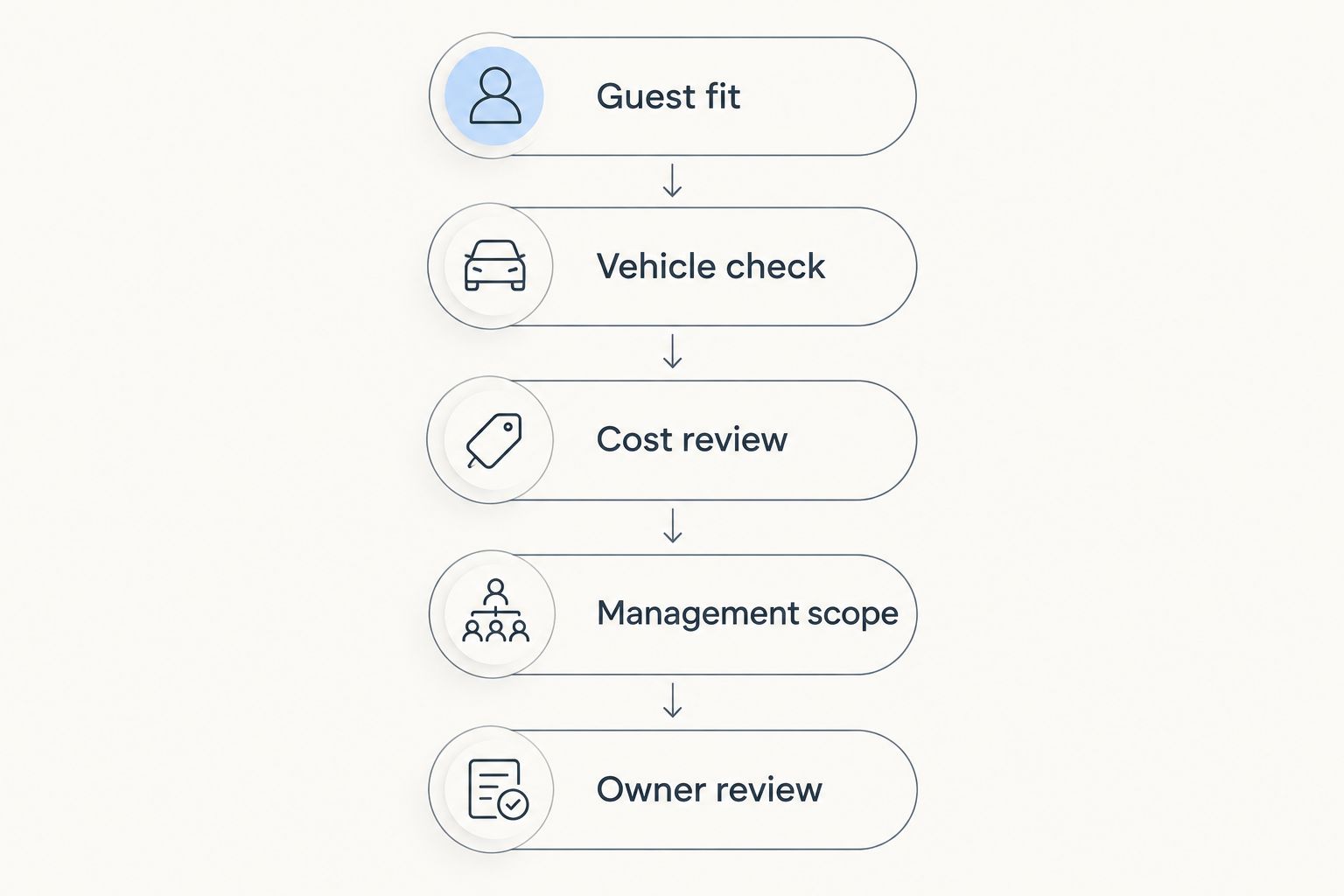
For passive-income planning in 2026, put the operating agreement beside the vehicle assessment. A management service and a suitable car solve different problems.
- Guest fit: Write down the trip and passenger needs the vehicle serves.
- Vehicle check: Verify eligibility, condition, equipment, and service history.
- Cost review: Account for financing, maintenance, cleaning, parking, and other ownership obligations.
- Management scope: Assign booking communication, handoffs, cleaning, maintenance coordination, and charging where relevant.
- Owner review: Define what records you receive and how unresolved issues reach you.
Use this sequence before committing, not after the vehicle arrives. Unassigned work remains work, even when the purchase was described as passive income.
Ask Drivev3 which responsibilities its management arrangement covers for your vehicle and location. The company manages Turo and private rentals, but the agreement—not the category label—defines your remaining workload.
Discuss your vehicle management plan
Ask which responsibilities are covered for your vehicle and location.
Which Turo vehicle should you choose?
Choose the Toyota Camry as the default passenger-travel shortlist candidate. Move to another vehicle only when you can name the requirement it satisfies better: compact packaging, luggage access, electric driving, or additional seating rows.
The best purchase is not established by a model name. It requires a suitable individual vehicle, a defined guest use case, and an ownership plan you can support without treating gross rental receipts as personal income.
FAQ
What's the best car for Turo in 2026?
Toyota Camry is the default recommendation here for balanced passenger travel. Toyota Corolla, Toyota RAV4, Tesla Model 3, and Honda Odyssey serve different guest needs; none establishes a universal profit winner.
Is a Toyota Corolla better than a Toyota Camry for Turo?
Toyota Corolla is the better fit for a compact-transportation brief; Toyota Camry is the default for balanced passenger travel. Compare the actual vehicles' condition and ownership obligations before choosing.
Is a Tesla Model 3 a good Turo vehicle?
Tesla Model 3 fits guests comfortable with electric driving when the owner has a defined charging process. Confirm battery condition, charging responsibilities, and guest instructions before buying.
Should I choose an SUV or a minivan for Turo?
Choose Toyota RAV4 for a luggage-focused SUV brief and Honda Odyssey when additional seating rows are the requirement. Check luggage space with the passenger seats in their intended configuration.
Does listing a car on Turo create passive income?
Listing a car on Turo does not remove the operating work. Cleaning, handoffs, maintenance, guest communication, and ownership obligations require either your attention or an assigned management process.
How much does it cost to own a Turo vehicle?
Ownership obligations depend on the specific vehicle, financing, maintenance needs, parking, and operating arrangement. Review those commitments separately from rental receipts before deciding.
What should I check before buying a car for Turo?
Check current platform eligibility, vehicle condition, service history, passenger capacity, and operating responsibilities. Evaluate the exact vehicle rather than treating its model name as a purchase approval.
One last thing
Test cargo space with the passenger seats occupied in their intended configuration. A photo of a large loading area with folded seats does not answer whether your guests and their bags fit together. That simple check connects the vehicle you buy to the trip you actually intend to serve.