Best overall: a midsize SUV. Best for family seating flexibility: a three-row SUV. Best for lighter luggage and tight parking: a compact SUV. This 2026 SUV rental Las Vegas guide compares vehicle types by passengers, bags, parking and route—not by a badge that tells you little about the actual vehicle.
- For SUV rental Las Vegas trips, a midsize SUV is the default choice; check the exact vehicle before booking.
- Drivev3 offers premium-car rentals in Las Vegas, including SUVs; match the vehicle to your passengers and luggage.
- Choose a three-row SUV for seating flexibility, a full-size SUV for larger loads, or a compact SUV for lighter trips.
- Choose an electric SUV only after checking charging access, the planned route and the return-charge requirement.
Why this matters
An SUV category is not a packing plan. Passenger seats, usable luggage space and parking demands depend on the exact model and how you arrange its seats. A vehicle that works for a couple visiting the Strip can be the wrong choice for a group carrying suitcases.
Drivev3 is a premium-car rental option for Las Vegas travelers considering an SUV. Drivev3 rents premium cars to consumers in Las Vegas, Bullhead City and Laughlin, including SUVs. Choose the vehicle around your trip rather than assuming that every SUV fits the same job.
For your 2026 reservation, settle the passenger and luggage questions before comparing vehicle features. That order keeps an attractive vehicle from becoming an awkward fit.
What makes the best SUV rental in Las Vegas?
Use these criteria to judge an SUV before you commit:
- Passenger fit: Count everyone traveling together and identify which seats you will actually use. A listed seat count does not describe access or personal comfort.
- Luggage fit: Check the cargo area with your intended seats upright. Space gained by folding a seat does not help when a passenger needs it.
- Parking fit: Match the vehicle's dimensions to the garages and parking spaces on your itinerary. Check posted clearance before entering a garage.
- Route fit: Separate city driving from longer excursions. For an electric SUV, include charging stops and your destination's charging arrangements.
- Vehicle certainty: Confirm the exact model or the substitution terms. Category labels alone do not establish dimensions, features or luggage capacity.
- Rental terms: Read the mileage allowance, driver requirements, protection terms, pickup instructions and fuel or charge return requirement.
Keep the checklist concrete. For example, a trip with 2 adults and 2 suitcases presents a different packing problem from one with 4 adults and 4 suitcases. These are planning examples, not capacity claims for any SUV.
Las Vegas SUV rentals at a glance
The ranking below compares rental types, not confirmed vehicles in a particular fleet. Each type earns its place through a distinct use case; exact specifications belong to the vehicle you select.
| Rank and SUV type | Best for | Standout feature to check | Key limitation |
|---|---|---|---|
| 1. Midsize SUV | Mixed city driving and day trips | Usable cargo space behind occupied seats | The category does not guarantee luggage fit |
| 2. Compact SUV | Light luggage and frequent parking | Exterior dimensions and rear-seat space | Less room to absorb extra passengers or bags |
| 3. Three-row SUV | Families needing seating flexibility | Third-row access and cargo space with seats upright | Passenger seating can consume luggage space |
| 4. Full-size SUV | Groups prioritizing room for passengers and gear | Seating layout and usable cargo area | Larger dimensions demand more parking attention |
| 5. Electric SUV | Trips with a defined charging plan | Charging compatibility and route access | Charging and return requirements add planning |
1. Midsize SUV: best for mixed Las Vegas trips
A midsize SUV is the first category to consider when your itinerary combines hotels, restaurants, errands and a day trip. It provides a sensible starting point between a smaller footprint and a larger vehicle's space demands. The exact model still determines whether that balance works for you.
For a 2026 trip without unusual passenger or luggage requirements, start here. Check the cargo area with the rear seats upright rather than relying on a photograph showing them folded.
Midsize SUV pros:
- A useful starting category when neither maximum seating nor minimum size is your priority.
- Lets you compare passenger comfort and luggage space together.
- Avoids choosing a larger vehicle solely because the trip includes an excursion.
Midsize SUV cons:
- The midsize label does not establish a standard seating or cargo layout.
- Bulky luggage can make a seemingly suitable vehicle a poor fit.
- Features shown for one trim do not confirm features on the rental vehicle.
Best for: Travelers combining everyday Las Vegas driving with excursions, without needing extra seating rows.
Before reserving, ask whether all your bags fit behind the seats you will use. If the answer depends on folding an occupied seat, move to a different vehicle rather than trying to solve the problem at pickup.
Verdict: Buy the midsize fit when the exact vehicle accommodates your passengers and bags.
2. Compact SUV: best for light packing and frequent parking
A compact SUV belongs near the top of your shortlist when you travel light and expect frequent parking stops. Start with its actual exterior dimensions, then inspect the rear seat and cargo layout. A category name is not a substitute for those checks.
Consider a planning example with 2 travelers and 2 carry-on bags. That trip does not automatically require a larger SUV, but the bags still need to fit without obstructing visibility or occupying a needed seat.
Compact SUV pros:
- A smaller vehicle footprint is useful when parking space is a priority.
- Suits a shortlist focused on lighter luggage rather than unused seating.
- Keeps your selection centered on the space you need, not the largest category offered.
Compact SUV cons:
- Extra bags or passengers can change the fit quickly.
- Rear-seat comfort requires attention when adults will sit there throughout the trip.
- A compact SUV is not automatically the right answer for a family with bulky equipment.
Best for: Solo travelers or couples who pack lightly and prioritize parking fit.
Inspect the bags themselves, not just their count. A rigid suitcase, stroller or equipment case creates a different problem from a soft bag that can fit around other luggage.
Verdict: Buy the compact fit for a light load; skip it when your luggage needs overflow into passenger space.
3. Three-row SUV: best for family seating flexibility
A three-row SUV adds another seating row, but that row changes the packing equation. You need to evaluate passenger access and the remaining luggage area together. Comparing cargo space with the third row folded misses the point if someone will sit there.
For a family trip in 2026, decide which passengers will use each row before choosing the vehicle. If you use child restraints, check the vehicle manual and restraint instructions for installation compatibility.
Three-row SUV pros:
- Adds seating arrangements beyond a two-row layout.
- Allows different passenger-and-cargo configurations when seats fold independently.
- Gives families a category to evaluate when a two-row vehicle does not meet seating needs.
Three-row SUV cons:
- An occupied third row leaves less space for luggage than a folded third row.
- Access and comfort vary by vehicle and seating arrangement.
- Child-restraint placement can affect how passengers reach the rear row.
Best for: Families who need another seating row and can verify luggage fit in that configuration.
Ask for a view of the cargo area with every required seat upright. Then check whether the passengers assigned to the rear row can enter and exit without disrupting the rest of your seating plan.
Verdict: Buy for verified seating flexibility; hold if the luggage plan relies on folding seats you need.
4. Full-size SUV: best for passengers plus bulky gear
A full-size SUV is the category to investigate when luggage and passenger needs make smaller options unsuitable. Do not treat the label as a guarantee that everything fits. Compare the exact vehicle's seating arrangement, cargo layout and dimensions.
A group carrying rigid suitcases or bulky equipment needs a load plan, not simply a bigger-looking vehicle. Identify what must remain accessible during the drive and what can stay packed until arrival.
Full-size SUV pros:
- A relevant category to compare when smaller SUVs fail your space check.
- Lets you prioritize passenger room and cargo needs in the same search.
- Provides another option when carrying bulky gear makes a compact layout impractical.
Full-size SUV cons:
- Larger dimensions require more attention in garages and parking spaces.
- Extra exterior size does not guarantee the cargo layout you need.
- Selecting by category alone can leave passenger access or luggage fit unresolved.
Best for: Groups whose passengers and gear cannot fit comfortably in the smaller vehicles under consideration.
Check hotel parking instructions before pickup. Look at clearance, access restrictions and the practicality of unloading luggage where you plan to stop.
Verdict: Buy for a demonstrated space need; skip the extra size when a smaller SUV already fits.
5. Electric SUV: best for a trip with planned charging
An electric SUV is a propulsion choice, not a size class. It can overlap with compact, midsize or larger layouts, so you still need to check seats and luggage first. Its distinct decision point is charging.
For an electric SUV rental in 2026, build charging into the itinerary before choosing the vehicle. Confirm connector compatibility, usable charging locations and the charge level required at return; do not assume any of these from the SUV's appearance.
Electric SUV pros:
- Fits travelers who specifically want an electric driving experience.
- Can suit an itinerary organized around confirmed charging stops.
- Lets you evaluate charging access as part of the route rather than as an afterthought.
Electric SUV cons:
- A charger listing does not establish that the equipment works with your vehicle.
- Charging stops need to fit your travel schedule.
- The return-charge requirement can affect the final part of your trip.
Best for: Travelers willing to plan charging at their destinations and along their route.
Drivev3's rental business includes Teslas, but that does not establish the body style or specifications of a particular Tesla. If you want an electric SUV, confirm the exact vehicle rather than treating the brand name as proof of SUV fit.
Verdict: Buy only with a defined charging plan; hold when charging access remains unresolved.
Check the fit before you reserve
Use this sequence to turn the ranking into a vehicle decision. Complete the space checks before moving on to features or pickup arrangements.
- Count passengers. Include everyone who will travel together, then identify rear-row passengers and any child restraints.
- List luggage. Write down suitcases, strollers and equipment. Note which items are rigid or unusually shaped.
- Check the vehicle. Confirm the model, seating layout and cargo space with the required seats upright.
- Check the route. Review parking access, planned excursions and charging arrangements where relevant.
- Read the terms. Confirm driver eligibility, mileage rules, pickup details and the fuel or charge return requirement.
The order matters. A vehicle that fails the passenger or luggage check should leave your shortlist before you spend time comparing convenience features.
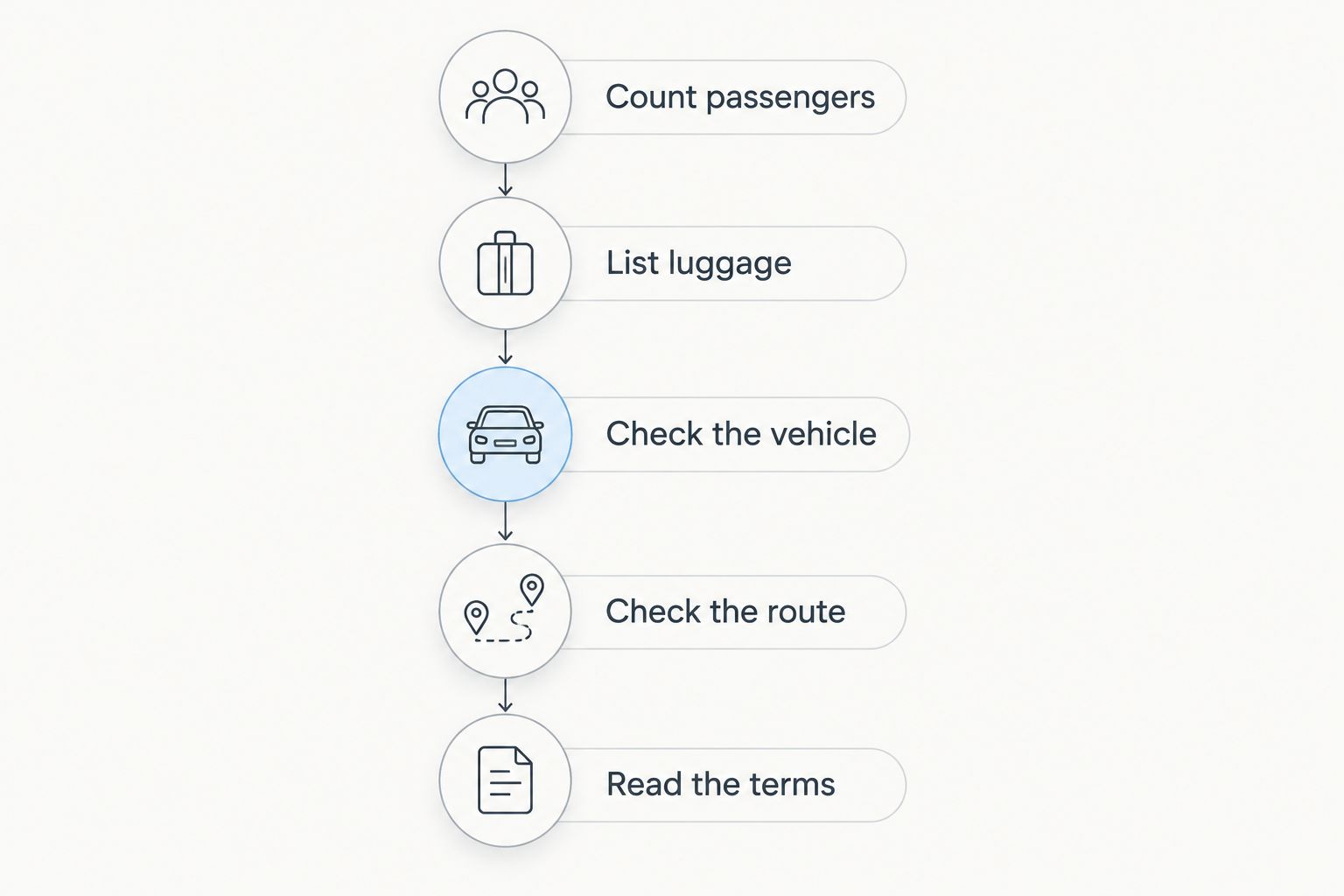
For a 2026 booking, keep the confirmed vehicle details and rental instructions together. That gives you a clear reference when checking the vehicle at pickup.
Explore your Las Vegas rental options
Match your passenger count, luggage and itinerary to the vehicle before you reserve.
How the SUV types are ranked
This ranking prioritizes passenger fit, luggage fit, parking, route requirements and vehicle certainty. Midsize SUVs take the default position because they are the starting category for a mixed itinerary without a specialized seating or load requirement.
The other positions answer different needs, not universal performance claims. Compact SUVs address lighter packing; three-row SUVs address seating flexibility; full-size SUVs address larger loads; electric SUVs address a charging-ready itinerary.
Drivev3 SUV rental decisions should use the same checks: exact vehicle, occupied seats, luggage layout and route. No category wins when the particular vehicle fails your trip requirements.
Which SUV should you choose?
Start with a midsize SUV unless your passenger count, luggage or charging preference gives you a clear reason to choose otherwise. Then test that choice against the actual vehicle.
Choose compact for a lighter load and a smaller footprint. Choose three-row for needed seating flexibility, or full-size when the smaller candidates fail your passenger-and-gear check. Choose electric only when charging works with your itinerary.
Do not upgrade by appearance alone. The right SUV is the one whose layout and rental terms fit the trip you will actually take.
FAQ
What's the best SUV rental in Las Vegas for an everyday trip?
A midsize SUV is the default category to consider for a mixed Las Vegas itinerary. Confirm that the exact vehicle fits your passengers and luggage with the required seats upright.
Is a compact SUV enough for two people in Las Vegas?
A compact SUV is a sensible category to consider for two people traveling light. Check the actual bags and vehicle layout rather than assuming that every compact SUV has the same cargo space.
Should I rent a three-row SUV for a family trip?
Choose a three-row SUV when your family needs the additional seating arrangement. Check luggage space with the third row in use and confirm child-restraint compatibility where needed.
Is a full-size SUV better than a midsize SUV?
A full-size SUV is the better choice when the specific midsize vehicles you are considering do not fit your passengers and gear. Extra size alone is not a reason to choose it, especially when parking fit matters.
What should I check before renting an electric SUV in Las Vegas?
Check the exact vehicle, charging compatibility, charging locations on your route and the return-charge requirement. Seats and luggage still need the same checks as they do in a fuel-powered SUV.
Does Drivev3 rent SUVs in Las Vegas?
Drivev3 rents premium cars to consumers in Las Vegas, including SUVs. Confirm the particular vehicle and its rental terms before making your reservation.
Can I take a rental SUV on an excursion outside Las Vegas?
Check the rental agreement before planning an excursion outside Las Vegas. Confirm permitted travel, mileage rules and any route restrictions, plus charging access if you choose an electric SUV.
One last thing
Compare luggage space with occupied seats upright—not with the cabin arranged for a promotional photo. Folding a row can make an SUV look spacious while hiding the packing problem your group will face.
Before committing, ask one precise question: does this exact vehicle fit all our passengers and bags at the same time? That answer is more useful than the category badge.