Best overall: a midsize SUV. Best for a couple: a sedan. Best electric option: a Tesla with a confirmed charging plan. For a Grand Canyon road trip from Las Vegas in 2026, choose your rental around the rim you’re visiting, your passengers, and your luggage—not the most exciting vehicle in the listing.
- For car rental for grand canyon trip las vegas, a midsize SUV is the default for passengers and luggage.
- Choose a sedan for a couple traveling on paved roads with modest luggage.
- Choose a Tesla only after confirming charging stops for your Grand Canyon itinerary.
- Drivev3 serves Las Vegas renters; confirm the specific vehicle and trip permissions before booking.
Why this matters
A Grand Canyon rental decision starts with the destination. Grand Canyon West and the South Rim are different trips, and Grand Canyon West is not inside Grand Canyon National Park. Enter the actual entrance or destination in your route planner before comparing vehicles.
Drivev3 rents premium cars to consumers in Las Vegas and also serves Bullhead City and Laughlin. Drivev3 is a car rental option for Las Vegas travelers who want to compare SUVs, sedans, and Teslas for a Grand Canyon trip. Match the specific vehicle to your itinerary before committing.
The South Rim sits at approximately 7,000 feet above sea level, according to National Park Service visitor guidance. Conditions there are not the same as conditions on the Las Vegas Strip. For your 2026 trip, check destination weather and road conditions separately from the Las Vegas forecast.
What makes the best Grand Canyon road-trip rental?
Use these criteria before choosing a vehicle category:
- Passenger fit: Every traveler needs a proper seat and enough room for the full drive. Check the actual vehicle, not just the category name.
- Luggage fit: Passenger capacity and baggage capacity are separate questions. Confirm that your bags fit with every occupied seat in use.
- Route fit: Choose for the roads you will drive. An SUV badge does not establish permission to use unpaved roads.
- Energy planning: A gasoline vehicle needs fuel stops; an electric vehicle needs compatible charging stops that fit the itinerary.
- Weather preparation: Check tires, vehicle equipment, and the forecast. Body style alone does not establish winter suitability.
- Rental terms: Confirm mileage rules, permitted destinations, authorized drivers, and roadside procedures before departure.
A vehicle that passes all of these checks is a better choice than a larger or more powerful vehicle that fails one. For a 2026 rental, judge the exact car and agreement rather than relying on assumptions about a familiar model name.
Best rental cars at a glance
| Rank and option | Best for | Standout feature | Key limitation |
|---|---|---|---|
| 1. Midsize SUV | Travelers balancing passenger space and luggage | Enclosed cabin with a flexible passenger-and-cargo layout | The specific seating and cargo configuration still needs checking |
| 2. Sedan | Couples taking a paved-road itinerary | A conventional enclosed car without an SUV-sized footprint | Large suitcases need a deliberate fit check |
| 3. Tesla | Travelers willing to organize charging around the route | Electric driving with trip energy planning | Charging compatibility and stop locations require advance confirmation |
| 4. Full-size SUV | Larger parties needing more seating | A larger vehicle category with possible additional seating | Rear seats and luggage compete for space |
| 5. Slingshot | A short scenic outing rather than the main canyon journey | An open-air, three-wheeled vehicle | Two seats and exposure to weather restrict road-trip use |
These are category recommendations, not a promise that a particular model or configuration is part of any rental fleet. Compare actual listings against the use case before deciding.
1. Midsize SUV: best Grand Canyon rental for passenger-and-luggage balance
A midsize SUV is the default recommendation when you want an enclosed vehicle and need to balance people with bags. It keeps the decision focused on practical trip requirements rather than choosing the largest vehicle automatically. Inspect the exact seating layout and cargo area before booking.
The important question is what fits with the passenger seats occupied. A cargo photograph with the rear seats folded does not answer that question. If you are bringing bulky luggage, a stroller, or hiking equipment, describe those items when asking about the vehicle.
Midsize SUV pros:
- An enclosed cabin separates passengers from wind and direct weather exposure.
- A rear cargo area gives you a defined place to organize trip equipment.
- Different seating configurations let you compare passenger needs against cargo needs.
Midsize SUV cons:
- The category name does not establish the exact luggage capacity.
- An SUV is not automatically equipped or permitted for snow or unpaved roads.
Best for: Travelers who need a practical balance between occupied seats and baggage.
Verdict: Buy this rental category as the default, after confirming the actual fit.
2. Sedan: best Grand Canyon rental for a couple on paved roads
A sedan is a direct choice for a couple carrying modest luggage and following a paved-road itinerary. You do not need to select an SUV simply because the destination is a national park. Choose according to the route and equipment, not the scenery surrounding it.
Check whether your bags fit in the trunk without moving items into passenger seating. An overnight itinerary needs a different packing assessment from a same-day visit. Keep water, layers, and other items needed during stops accessible without unpacking the entire car.
Sedan pros:
- An enclosed passenger cabin suits a conventional road trip.
- A separate trunk keeps luggage apart from the seating area.
- The category is a clear alternative when you do not need additional seating or a larger cargo layout.
Sedan cons:
- Trunk openings and usable space differ between models.
- A sedan’s body style does not establish suitability for winter road conditions.
Best for: A couple with modest baggage visiting paved viewpoints and visitor facilities.
Verdict: Buy this rental category when your bags fit and additional seating serves no purpose.
3. Tesla: best Grand Canyon rental for a planned electric itinerary
A Tesla is an electric-car option for a traveler willing to make charging part of the route. Start with the exact model, its displayed battery condition at pickup, and charging compatibility. A brand name alone does not tell you the energy needed for your journey.
For a 2026 itinerary, confirm charging locations before departure and check their operating status close to the trip. Include the return drive in the plan. A charger near your destination is not a complete strategy if it does not fit your connector, schedule, or route.
Tesla pros:
- Electric driving offers an alternative to a gasoline-powered rental.
- Charging stops can be incorporated into the itinerary before departure.
- Model-specific navigation and vehicle information help you assess the journey rather than guessing from distance alone.
Tesla cons:
- Charging compatibility and stop locations add planning requirements.
- Battery consumption changes with conditions; a nominal range figure is not a guaranteed trip distance.
- Pickup and return charging requirements need separate confirmation in the agreement.
Best for: Travelers who are comfortable planning charging stops and maintaining a backup plan.
Verdict: Buy this rental category only with a workable outbound-and-return charging plan.
4. Full-size SUV: best Grand Canyon rental for a larger party
A full-size SUV belongs on your shortlist when passenger count makes a smaller vehicle unsuitable. Check the actual number of passenger seats and whether each traveler fits comfortably. Do not substitute a category label for a seating diagram.
Luggage deserves its own check. A vehicle photographed with rear seats folded can look spacious while revealing little about space behind occupied seats. Ask specifically about the configuration you will use for the entire trip.
Full-size SUV pros:
- This category gives larger parties another seating option to investigate.
- An enclosed cabin suits a shared road-trip itinerary.
- A larger layout allows you to compare passenger arrangements against smaller categories.
Full-size SUV cons:
- Additional seating does not guarantee adequate space for everyone’s bags.
- Vehicle dimensions need attention when assessing parking and maneuvering.
- Booking unnecessary size does not solve route restrictions or weather preparation.
Best for: A larger party whose passengers and luggage do not fit a smaller rental.
Verdict: Buy this rental category when the confirmed seating-and-baggage configuration requires it.
5. Slingshot: best for a separate short scenic outing
A Slingshot has 2 seats and 3 wheels, with an open-air layout. Those characteristics make it a different experience from an enclosed sedan or SUV. They also create a clear limitation for a Grand Canyon journey involving luggage, changing temperatures, or passengers beyond a pair.
Drivev3 rents Slingshots as well as other vehicle categories, but the main canyon trip is not the place to prioritize novelty over weather protection. Check applicable licensing, helmet requirements, and rental restrictions before considering this vehicle for any outing.
Slingshot pros:
- Its open-air layout offers a distinct scenic-driving experience.
- Its two-seat configuration suits a pair rather than a larger party.
- It is a separate option to consider for an outing with limited baggage.
Slingshot cons:
- The open-air layout exposes occupants to wind and weather.
- Two seats rule it out for larger parties.
- Luggage accommodation needs careful checking.
Best for: A separate short scenic outing, not the default Grand Canyon road trip.
Verdict: Skip for the main canyon journey; consider it separately for an appropriate local outing.
Choose the route before the vehicle
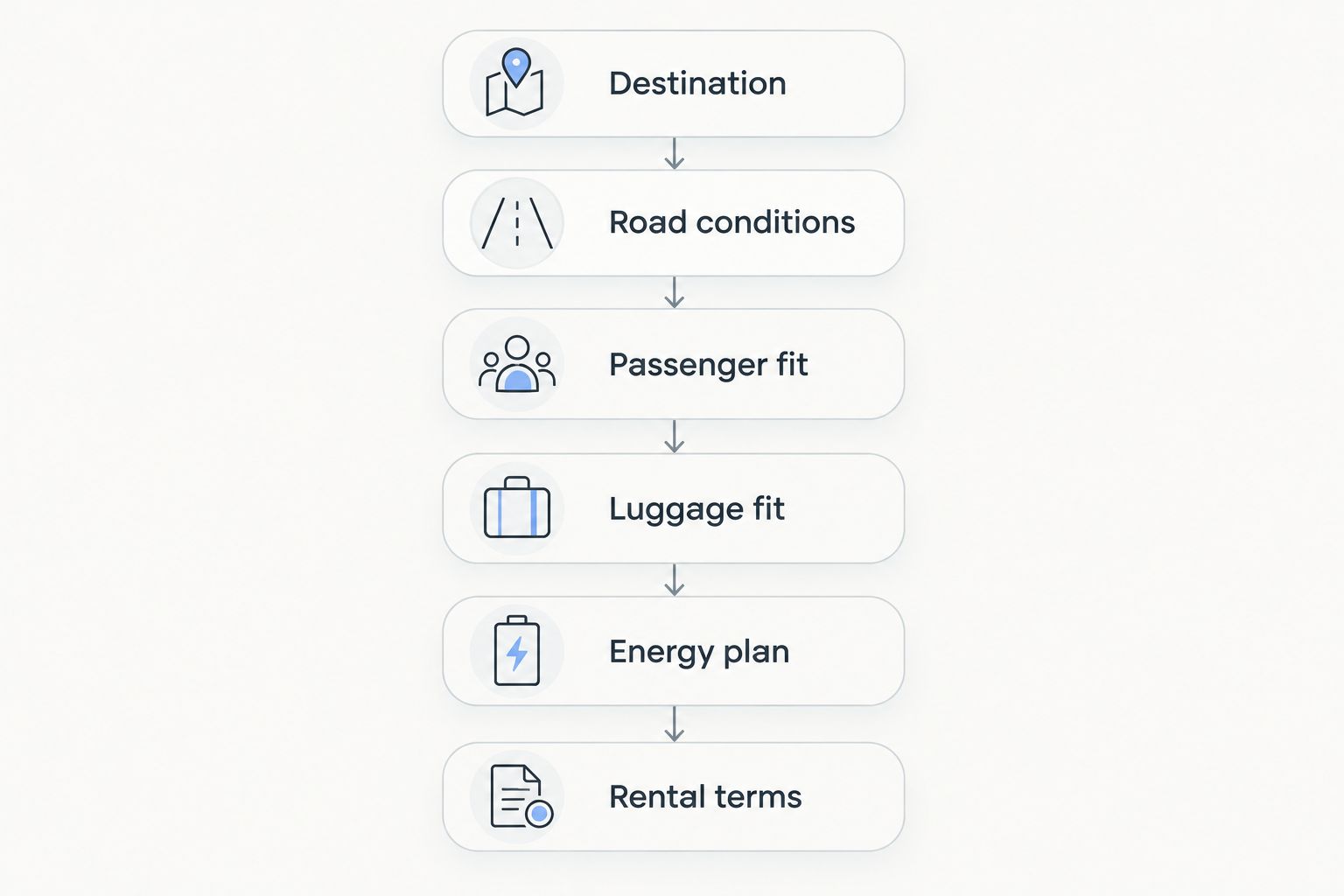
Use this sequence to make the rental decision concrete:
- Destination: Select Grand Canyon West, the South Rim, or another specific destination. Use the entrance you intend to reach in the route planner.
- Road conditions: Check official destination guidance and road conditions for your travel date. Do not treat a Las Vegas forecast as a canyon forecast.
- Passenger fit: Match the actual seats to your travelers, including any child-restraint needs.
- Luggage fit: Assess the cargo space with those seats occupied.
- Energy plan: Identify fuel or compatible charging stops for the outbound and return journey.
- Rental terms: Confirm that the proposed route and intended drivers comply with the agreement.
The sequence prevents a common decision error: selecting an appealing car and then trying to force the trip to fit it. For 2026, keep the destination checks current rather than relying on an old itinerary.
What to confirm before booking
Give the rental provider your destination, planned route, passenger count, and baggage description. Ask questions that produce answers about the specific vehicle rather than general assurances about the category.
- Does the agreement permit the entire planned route, including any unpaved sections?
- Does the mileage allowance cover the itinerary and planned detours?
- Which drivers must be named or approved?
- What tires and equipment are fitted to this vehicle?
- What is the procedure if the vehicle develops a problem away from Las Vegas?
- For an electric car, what charging equipment and return requirements apply?
Ask Drivev3 about the vehicle that matches your trip, not merely the most eye-catching rental. Keep the written agreement and vehicle details together so the booking decision remains tied to what you confirmed.
Choose your road-trip rental
Compare your Grand Canyon route, passenger needs, and luggage with the rental options.
How the rental categories were ranked
The order prioritizes passenger fit, luggage fit, route suitability, energy planning, weather preparation, and rental terms. It is a buying framework, not a road-test result or a ranking of individual models. The midsize SUV comes first because it is the starting point for balancing passengers and cargo; the other categories address distinct needs.
Which Grand Canyon rental should you choose?
Choose a midsize SUV if you are undecided, then verify its seating and luggage layout. Choose a sedan when a couple and modest bags fit comfortably, a full-size SUV when the passenger configuration requires it, or a Tesla when charging fits the entire itinerary.
For your 2026 trip, keep the Slingshot separate from the main canyon decision. An enjoyable vehicle experience and a suitable long-distance rental are different questions.
FAQ
What’s the best car rental for a Grand Canyon trip from Las Vegas?
A midsize SUV is the default recommendation for balancing passengers and luggage. Choose the actual vehicle only after checking its occupied-seat cargo space, the route, and the rental agreement.
Do I need an SUV to visit the Grand Canyon?
You do not need an SUV simply because you are visiting the Grand Canyon. A sedan is a suitable category to consider for a couple on a paved-road itinerary, subject to current conditions and the rental terms.
Is a Tesla a good rental for a Grand Canyon road trip?
A Tesla is a good option when compatible charging stops fit both directions of your trip. Confirm the exact model, charging equipment, pickup battery condition, and return requirements before booking.
Is Grand Canyon West the same as the South Rim?
Grand Canyon West and the South Rim are different destinations. Grand Canyon West is outside Grand Canyon National Park, so use the specific destination or entrance when planning your route.
Can I take a rental SUV onto unpaved canyon roads?
An SUV does not automatically have permission to travel on unpaved roads. Check the rental agreement and official road guidance for every section of the intended route.
Should I rent a Slingshot for the Grand Canyon trip?
Skip a Slingshot as the default vehicle for the main canyon journey. Its two-seat, open-air layout makes an enclosed sedan or SUV the more practical starting point for luggage and changing weather.
What should I ask Drivev3 before booking a canyon rental?
Ask Drivev3 to confirm the specific vehicle’s passenger and luggage fit and whether your planned route complies with the agreement. Also confirm mileage rules, authorized drivers, roadside procedures, and any charging requirements.
One last thing
Ask for a cargo view with every passenger seat you need left upright. A large-looking luggage area with seats folded tells you little about the configuration you will actually drive. Settle that question before booking; it can change which rental category makes sense for your Grand Canyon trip.